
The ₹5Cr Trap Nobody Warns You About
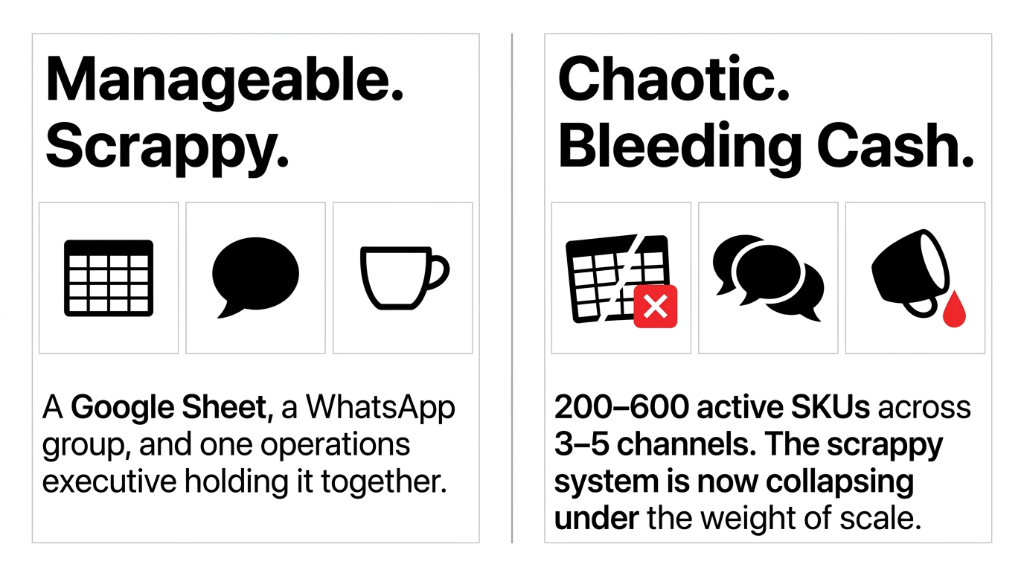
At ₹50 lakh, your operations were manageable. Scrappy, yes. But manageable. A Google Sheet for inventory, a WhatsApp group for the warehouse, Razorpay for reconciliation, and one operations executive who somehow held it all together with coffee and anxiety.
Then you crossed ₹5 crore. And that same system is now collapsing under the weight of 200–600 active SKUs across 3–5 channels.
Here Is Exactly What Is Breaking
Inventory sync lag between Shopify, Amazon, and Flipkart means you're selling units you don't have — and killing your seller ratings in the process
COD return chaos where 40–60% of your orders are cash-on-delivery, and your RTO rate sits between 15–25%, but nobody knows the real cost because it's buried in three different spreadsheets
Festival-driven demand spikes that your forecasting (read: gut feeling) can't handle — so you either overbuy by ₹8–12 lakh or run out of stock on Day 1 of the Big Billion Days sale
Month-end close taking 3 weeks because your finance team is still manually reconciling marketplace payouts, GST input credits, and TDS deductions in Excel
Your ops aren't broken because you're incompetent. They're broken because you built a ₹50L system and asked it to run a ₹5Cr business.
Why "Hire More Staff" Is the Worst Advice You've Been Given
Everyone tells you to hire. Hire a logistics manager. Hire an MIS analyst. Hire a finance controller. Don't. Hiring more staff isn't scaling — it's bloating.
We constantly see clients at ₹5Cr adding 4–6 headcount to solve problems that are fundamentally process and systems failures. Their monthly payroll goes up by ₹3.5–5L, and the errors still don't stop — because you've just added more humans to a broken process.
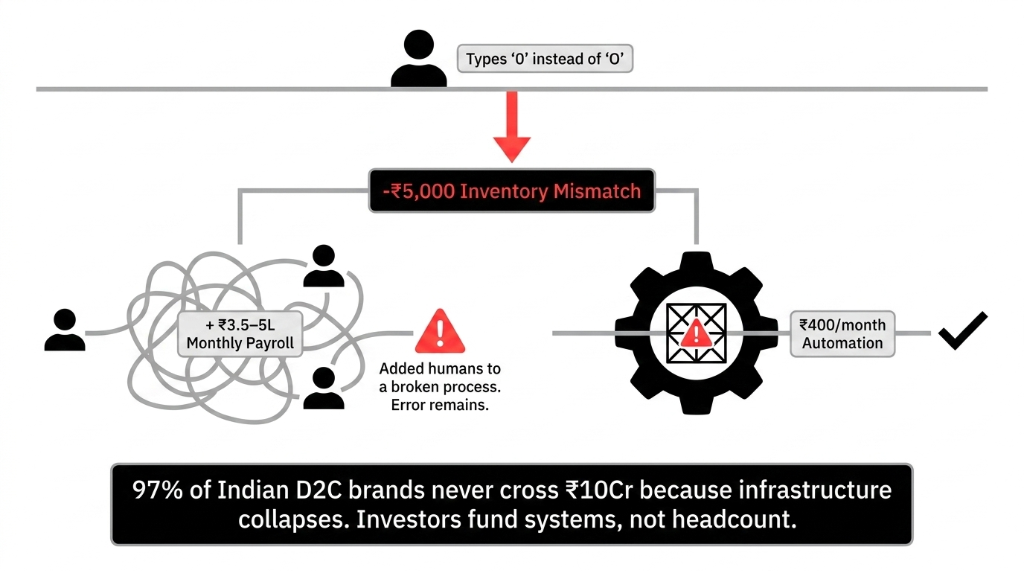
A warehouse executive typing a '0' instead of an 'O' in the SKU field causes ₹5,000 worth of inventory to disappear from your system. Hire another person to double-check? Now you've got two people manually checking what a ₹400/month Odoo automation would catch in real time.
What Your Operations Stack Should Actually Look Like at ₹5Cr
Here is what we implement for every ₹5Cr D2C brand we onboard at Braincuber. Not theory. The actual architecture.
1. Unified Inventory Across Every Channel
Your inventory must live in one place — not in Shopify's backend, not in a 3PL's portal, not in a WhatsApp message from your warehouse manager. At ₹5Cr, you're likely running 200–600 active SKUs across 3–5 channels. Every oversell event costs you ₹2,500–₹8,000 in return handling, customer refunds, and ratings damage.
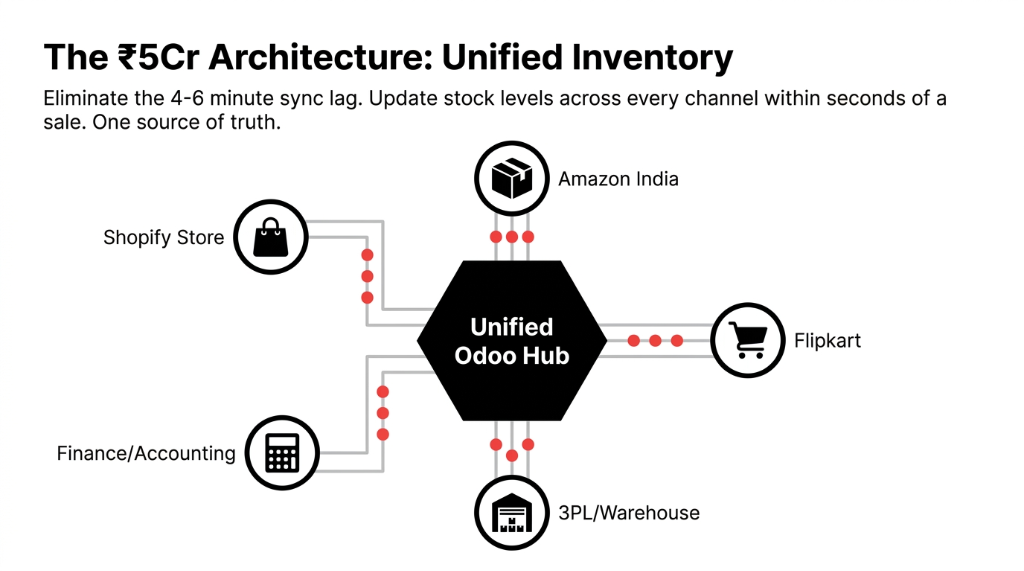
Odoo's multi-channel inventory sync eliminates this by updating stock levels across Shopify, Amazon, and Flipkart within seconds of a sale — not in the 4–6 minute lag that Shopify's standard inventory API produces during high-traffic periods. (Yes, that lag is real, and it is why you oversell during every sale.)
2. COD Reconciliation That Doesn't Require a Forensic Accountant
At ₹5Cr annual revenue, you are processing roughly ₹40–45L in COD orders every month. With an average RTO of 20%, that's ₹8–9L in returned orders monthly that need to be tracked, reconciled, and re-entered.
The COD Fix That Recovers ₹12,450/Month
We've seen clients leaking exactly ₹12,450 a month in un-reconciled COD returns — money that was collected by the logistics partner but never properly credited back.
Fix: Odoo's automated COD reconciliation cross-matches courier partner MIS sheets against sales orders every 24 hours, automatically flagging discrepancies above ₹500.
3. Demand Forecasting That Uses Data, Not Festivals
At ₹5Cr, a 10% forecasting error = ₹50L in either dead inventory or lost sales. That's not a rounding error. That's a cash flow crisis. Most Indian D2C brands are forecasting based on last year's festival performance + optimistic growth projections. You overbuy ahead of Diwali because last year you ran out, and then spend 3 months liquidating excess stock at 30–40% margin erosion.
Odoo's demand planning module uses 13-week rolling averages weighted by channel performance, giving you SKU-level reorder recommendations 3–4 weeks ahead of need — not the night before your stock hits zero.
4. GST + Marketplace Compliance on Autopilot
Zoho Books and QuickBooks handle simple GST. They do not handle the complexity of interstate vs intrastate TDS, platform-specific promotional deduction reconciliation, and multi-marketplace input credit claims simultaneously. At ₹5Cr revenue spread across Amazon, Flipkart, and your own Shopify store, you are managing 10+ promotions a month and running cross-state inventory.
Month-End Close: 21 Days Down to 4.5
Your accountant is manually piecing together marketplace payouts, GST credits, and TDS deductions. With Odoo's Indian localization module, month-end closes in 4.5 days, not 21.
5. Returns Management That Doesn't Eat Your Margin
A D2C brand with a 20% return rate and no automated returns processing spends approximately 37 hours of staff time per week just handling return logistics, restocking, refund processing, and customer communication. That's ₹55,000–₹70,000/month in hidden labor cost for a process that should be fully automated.
Odoo's returns portal triggers a refund workflow, updates inventory, notifies the warehouse for QC inspection, and logs the return reason — all without a single manual touchpoint.
The Results You Should Actually Expect
| Metric | Before Odoo | After 90 Days |
|---|---|---|
| Inventory Accuracy | 71% | 96.3% |
| COD Reconciliation Time | 14 hours/week | 1.5 hours/week |
| Returns Processing Cost | Baseline | 43% reduction |
| Month-End Close | 18–21 days | Under 5 days |
The Series A Story That Closed the Round
One Odoo client (a Mumbai-based skincare brand we onboarded in Q3 2024) pulled up live operational dashboards during their Series A pitch. The investor said, "This is the first founder who could answer my questions with data, not projections." They closed the round.
What Implementation Actually Takes
Stop listening to vendors who tell you ERP implementation takes 6 months. At ₹5Cr, you don't have the runway for that.
| Phase | Duration | What Gets Done |
|---|---|---|
| Discovery & Data Migration | Week 1–2 | SKU master, open orders, supplier list, channel mapping |
| Core Module Setup | Week 3–5 | Inventory, Sales Orders, Purchase Orders, COD workflows |
| Channel Integrations | Week 5–7 | Shopify–Odoo sync, Amazon/Flipkart MIS integration |
| Finance & GST | Week 7–9 | Chart of accounts, GST automation, bank reconciliation |
| Go-Live & Training | Week 9–10 | UAT, staff training, hypercare support |
Total: 8–10 weeks. Not 6 months. Not "it depends." 8–10 weeks. The fastest wins always come in weeks 1–3: COD reconciliation automation and returns workflow. If you're cash-strapped and need immediate ROI, prioritize these two before anything else.
Frequently Asked Questions
How long does Odoo implementation take for a D2C brand at ₹5Cr?
A focused Odoo implementation takes 8–10 weeks covering inventory sync, COD reconciliation, Shopify integration, GST automation, and basic finance. The first operational wins — reduced manual reconciliation and live inventory visibility — appear within the first 3 weeks.
What is the ROI from an ERP implementation in the first 90 days?
Most ₹5Cr brands recover their Odoo implementation cost within 60–90 days through three sources: reduced inventory discrepancies (saving ₹8,000–₹15,000/month), automated COD reconciliation (recovering ₹10,000–₹20,000/month in missed credits), and faster month-end close reducing finance staff overtime by 12–15 hours per week.
Can Odoo handle Indian marketplace integrations like Amazon and Flipkart?
Yes. Odoo integrates natively with Shopify and through certified connectors with Amazon India and Flipkart seller APIs. This enables real-time inventory sync, automated MIS reconciliation, and marketplace-specific TDS and commission tracking — all within a single dashboard. No manual CSV imports from Seller Central at 11 PM.
Is Odoo better than Zoho or QuickBooks for a D2C brand?
At ₹5Cr with multi-channel operations, yes. Zoho and QuickBooks handle accounting well. They do not handle warehouse management, demand forecasting, multi-channel inventory sync, and returns automation in a single connected system. Running separate tools costs more in integration maintenance than an all-in-one Odoo setup.
What happens to existing Shopify and inventory data during migration?
Your Shopify product catalog, open orders, and customer history migrate into Odoo with full data integrity in Week 1–2. Historical inventory data is enriched so your demand forecasting module has clean inputs from Day 1. Braincuber provides a parallel-run period of 2 weeks before full cutover for zero data loss.
Don't Let Broken Ops Kill a ₹50Cr Opportunity
Every month you run on spreadsheets, Zaps, and tribal knowledge locked in your ops manager's head, you pay a silent tax of ₹14,200–₹22,000. Book our free 15-Minute Operations Audit — we'll find your biggest leak on the first call.