
₹25Cr Is Where the Cracks Become Craters
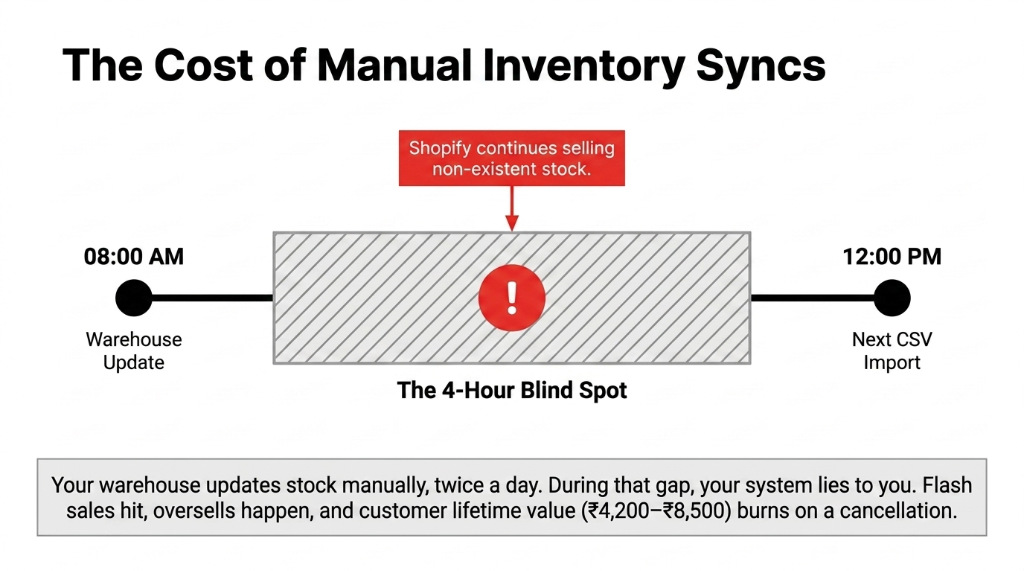
Inventory Reconciliation: The 4-Hour Blind Spot
Your warehouse team updates stock manually, twice a day. That 4-hour gap between actual stock movements and system updates means Shopify keeps selling products that don't exist. During a flash sale where 200 orders come in within 15 minutes, a stale inventory count creates oversells that burn ₹4,200–₹8,500 in customer lifetime value per cancellation.
Return Processing: 60–90 Orders Bouncing Back Daily
At ₹25Cr with a 23–31% RTO rate (standard for Indian fashion and lifestyle), if your restock efficiency is below 85%, that product spends 6–8 days labeled "in transit" while it's actually sitting in a courier bag in Bhiwandi. Your available inventory number is wrong. Your reorder trigger is wrong. Everything downstream is wrong.
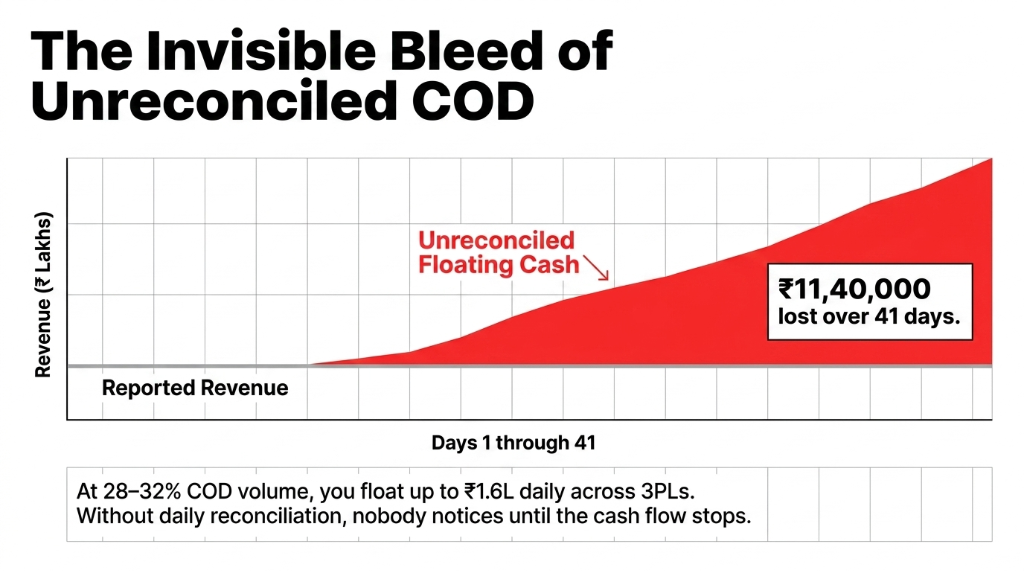
COD Remittances: ₹11,40,000 Nobody Noticed
At 28–32% COD volume, you're floating ₹80,000–₹1,60,000 in daily remittances across Delhivery, XpressBees, and Shiprocket. Without daily reconciliation, that number piles up. We caught one client sitting on ₹11,40,000 in unreconciled COD over 41 days. Nobody noticed.
The SKU Typo That Costs ₹3,40,000
When your warehouse executive types SKU "D1O2" instead of "D102" (that's an O, not a zero), you lose track of ₹3,40,000 worth of stock. It doesn't show as missing. It shows as available. Shopify keeps selling it. The customer gets a cancellation 3 days later.
We have seen this exact scenario 23 times across Indian D2C brands in the ₹20–40 crore range.
Why Everyone's Advice Is Wrong for Your Stage
Your CA says: "Get a proper ERP." Your investor says: "Hire a VP of Operations." Your SaaS vendor says: "Our platform is the answer." Frankly, all three are expensive half-truths.
The Cost of Bad Advice at ₹25Cr
NetSuite
₹35–55 lakh setup + ₹8–12 lakh/year licensing. At 18–22% EBITDA margins, that's your entire quarter's operating profit. Used at 30% capacity for the first 18 months.
More Ops Hires (x4)
₹6–9 lakh/year CTC each + ₹1.5–2 lakh in tools/training + 7-month attrition cycle. Four hires = ₹42 lakh/year. The automation that replaces them = ₹14–18 lakh. Once.
The "Integrate Later" Trap
Shopify + Shiprocket + Zoho CRM + QuickBooks stitched by 6 Zapier workflows and one ops manager who is your single point of failure. That person will quit during peak sale season.
What Actually Needs to Be Fixed at ₹25Cr
This isn't about buying software. It's about fixing four specific operational failures, in order.
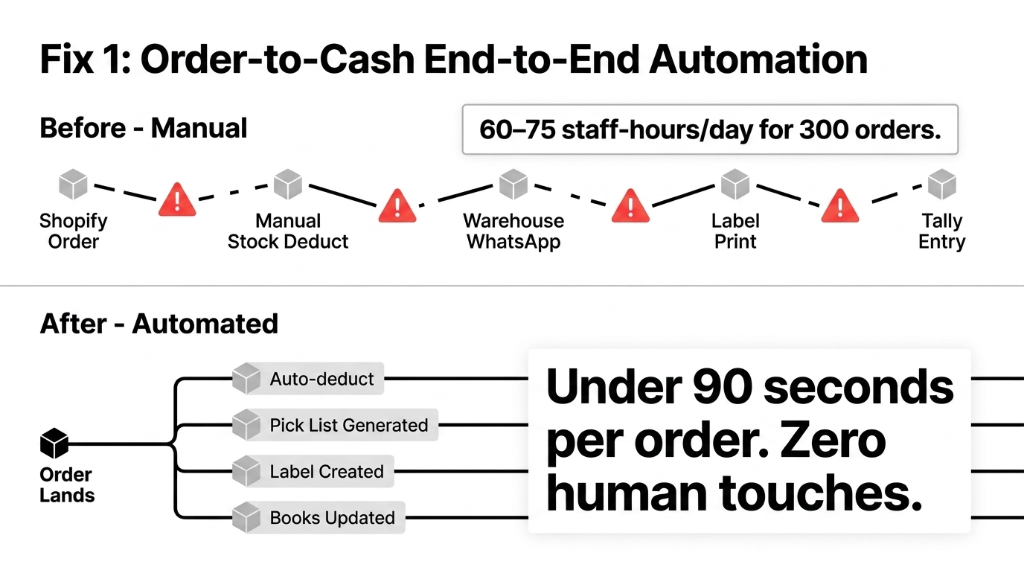
Fix 1: Order-to-Cash Must Be Automated End-to-End
When a Shopify order lands, inventory should auto-deduct, your warehouse should receive a pick list, courier label should generate, and your books should update — without a human touching anything. The current manual workflow takes 12–15 minutes per order. At 300+ daily orders, that's 60–75 staff-hours a day on order entry alone.
Fix 2: Demand Forecasting Must Run on Data, Not Gut
At ₹25Cr with 150–400 SKUs, manual reordering costs your team 37+ hours a month. The result: an average 23% stockout rate on your top 10 SKUs during festive events. When reorder points are calculated automatically from 90-day rolling velocity, lead time variance from suppliers, and category-level seasonality coefficients — you stop running out of bestsellers on Day 2 of a sale.
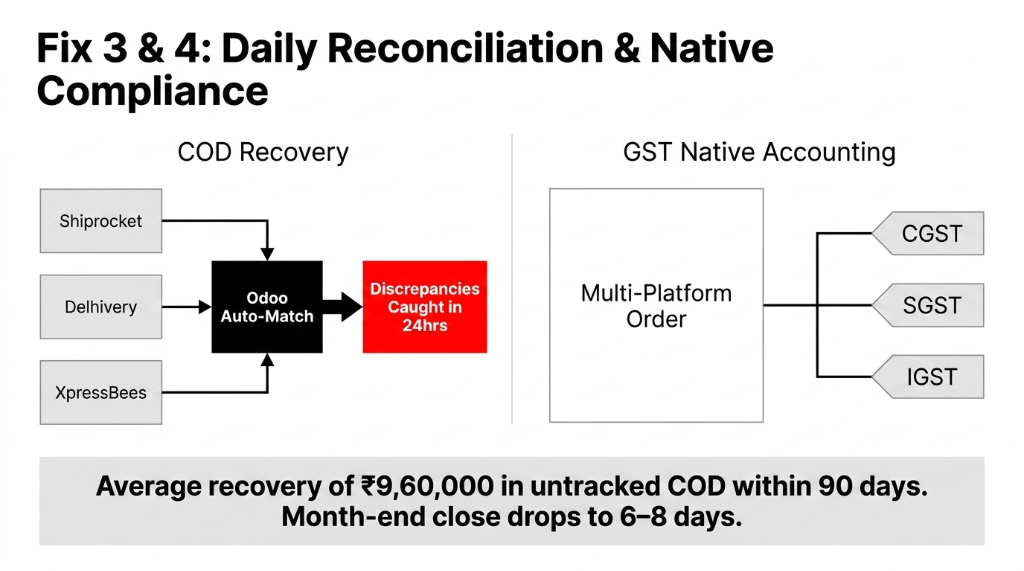
Fix 3: COD Reconciliation Must Happen Daily
Matching courier remittance files against open orders manually once a week is why that ₹11,40,000 went missing for 41 days. Automated daily reconciliation catches discrepancies in 24 hours, not 41 days.
Fix 4: GST Compliance Cannot Live in Excel
Indian D2C brands managing 10+ promotions monthly across Amazon and Flipkart need CGST/SGST/IGST tracked at the transaction level, with input credit calculated automatically. Your finance team is spending 14–18 hours a month correcting manual entry errors in the GST3B. That's billable time going into a data-cleaning black hole.
How Odoo ERP Solves This — Step by Step
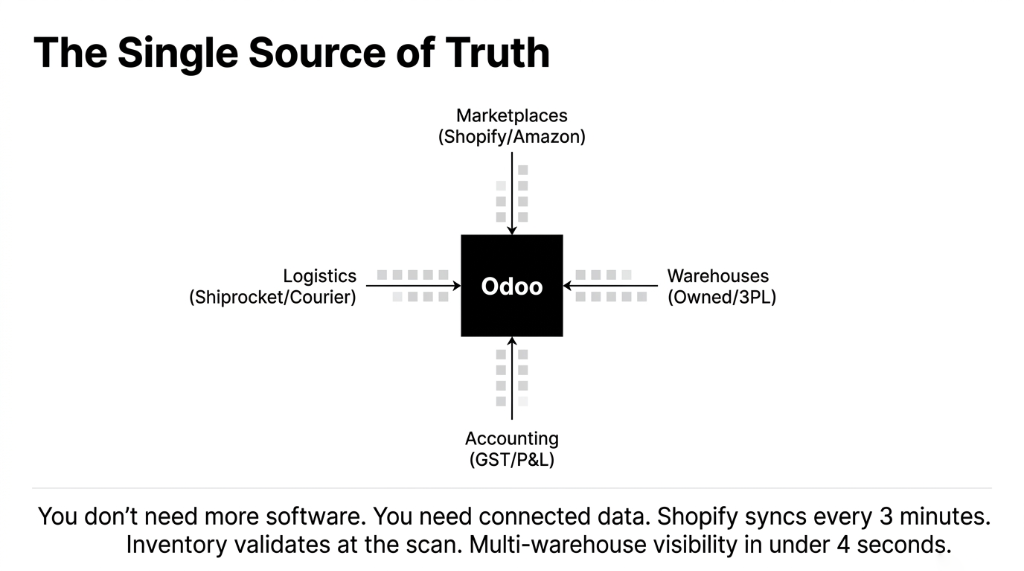
What Odoo Actually Delivers at ₹25Cr
▸ Shopify sync runs every 3 minutes — stock levels never more than 180 seconds stale vs. your twice-daily CSV import
▸ Inventory validation kills data entry errors at the source — SKU "D1O2" throws a validation error and stops the transaction
▸ COD reconciliation automated — pulls remittance files from Shiprocket, Delhivery, XpressBees daily, auto-matches against open orders
▸ Multi-warehouse visibility, live — every warehouse location, shelf bin, in-transit shipment tracked with lot-level traceability in under 4 seconds
▸ GST-native accounting — CGST/SGST/IGST handles automatically at invoice level. Month-end close drops from 27–35 days to 6–8 days
COD Recovery: ₹9,60,000 Average per Brand
In our last 12 implementations for Indian D2C brands in the ₹20–40Cr range, the custom COD reconciliation module recovered an average of ₹9,60,000 in previously untracked COD per brand within 90 days.
The Implementation Reality — No Surprises
| Phase | Timeline | What Happens |
|---|---|---|
| Discovery + Data Audit | Weeks 1–2 | Map every tool, find inventory count gaps (every client has at least 2–3) |
| Configuration + Integration | Weeks 3–6 | Shopify + marketplaces first, then warehouse module, then accounting |
| Parallel Run | Weeks 7–8 | Old system and Odoo run together; your team builds confidence |
| Go-Live | Week 9+ | Old system retired; ops team processes from a single source of truth |
Total Implementation Cost
₹12–18 lakh, one-time
Year-One Savings
₹24–38 lakh in recovered inventory, reduced ops headcount, and faster financial close
Only 2.1% of Indian D2C brands have crossed ₹150 crore. The ones who do aren't luckier. They fixed their operations before the operations fixed them.
Frequently Asked Questions
How long does Odoo ERP implementation take for a D2C brand at ₹25Cr?
For a brand doing ₹20–30Cr with 150–500 SKUs and 2–4 sales channels, implementation takes 8–10 weeks. This includes Shopify and marketplace integration, inventory module setup, accounting migration, warehouse configuration, team training, and a mandatory 2-week parallel run before go-live.
What ROI can a ₹25Cr D2C brand expect in the first 90 days?
Most brands in the ₹20–40Cr range recover ₹8–12 lakh in untracked COD remittances alone within 90 days. Add 18–22 hours per month saved in manual reconciliation, faster inventory turns, and reduced ops headcount — payback on full implementation cost typically happens within 5–6 months.
We're already on Shopify + Tally + Shiprocket. Do we replace everything?
No. Odoo connects directly to your existing Shopify store without a storefront migration. Tally gets decommissioned gradually once accounting goes live. Shiprocket, Delhivery, and XpressBees integrate via API. The goal is to unify your data in one system — not rip out every tool in week one.
How is Braincuber different from a freelance Odoo developer?
A freelance developer configures modules. We diagnose your operations first, then configure Odoo to fix your specific workflows. Braincuber has implemented Odoo for 150+ brands globally with pre-built connectors for Amazon, Flipkart, Meesho plus COD reconciliation templates built for Indian 3PL remittance formats.
What happens to existing inventory and accounting data during migration?
We run a full inventory audit before migration and reconcile Tally and Excel records against physical warehouse counts. All data is migrated in Odoo's staging environment first, validated by your team, and imported into production only after sign-off. You do not go live on bad data.
Stop Bleeding Cash on Ops That Have a Known Fix
Book our free 15-Minute Operations Audit — we'll identify your single biggest operational leak in the first call. No pitch. No fluff.