
The Exact Ops Stack That's Cracking at ₹1Cr
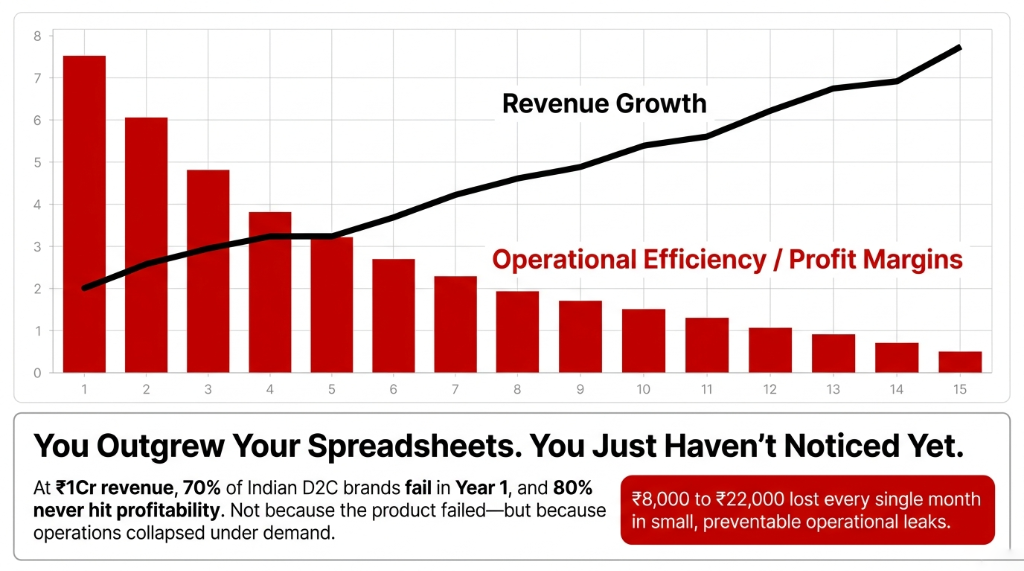
At ₹1 crore, you're processing roughly 200–500 orders per month depending on your AOV. That's enough volume to expose every manual process you have.
Inventory System: First to Break
Problem: When your warehouse team manually updates stock counts in a Google Sheet after each dispatch, and your Shopify store pulls from a separate database, you end up where a skincare brand in Mumbai did — they oversold their hero product by 340 units during a sale because the sheet hadn't been updated for 11 hours. Refunds cost them ₹1.87 lakh and 23 one-star reviews.
Returns Processing: Second Casualty
Indian D2C brands face a return rate of 18–35% on COD orders. At ₹1Cr revenue with a typical 60% COD mix, that means roughly ₹60,000–₹1,00,000 worth of returned inventory per month that nobody is properly logging, restocking, or accounting for. It just disappears into a grey zone between your logistics partner's system and your accounting software. (Yes, your accountant knows. They just haven't told you how bad it is.)
Order Fulfillment Tracking: Third Gap
Most brands at this stage are still calling their 3PL partner on the phone to check dispatch status. We worked with a D2C fashion brand in Ahmedabad — they had 47 orders stuck in "dispatched" status for 6+ days because their logistics partner's API wasn't syncing with Shopify. Their customer support team was fielding 80+ "Where is my order?" tickets per week manually, burning 37 hours of staff time every month on a problem that should have been automated.
Why "Hire More People" Is the Worst Advice You'll Hear
Every operations consultant worth nothing will tell you: "At ₹1Cr, you need to build a team." Don't. Hiring more staff isn't scaling. It's bloating.
We've seen brands add a warehouse manager, an operations executive, and a returns coordinator — and their operations costs go up by ₹2.4 lakh per month while their error rate drops by exactly 11%. The math doesn't work.
The Math That Kills Hiring at ₹1Cr
At ₹1 crore revenue, your operating margin is probably between 8–14% after CAC, logistics (which in India costs 14% of revenue versus 8–9% in developed markets), and returns. That leaves you ₹8–14 lakh in actual annual profit.
Hiring three people to manage operations manually eats that entirely. The answer is systems before staff. Every time.
The 4 Operations You Must Fix Before Spending Another Rupee on Ads
1. Inventory Sync — Real-Time, Not End-of-Day
Your Shopify store must reflect actual warehouse stock at every moment — not the count from last night's reconciliation. A 4-hour lag during a flash sale can oversell your top 3 SKUs and generate refund requests that take 7 business days to process. The fix is a direct inventory integration between your warehouse management system and Shopify, with automatic reorder triggers when any SKU drops below a set threshold. At Braincuber, we implement this through Odoo's inventory module, which cuts stock discrepancy incidents from an average of 19 per month to under 2.
2. Returns Management — Logged, Assessed, Restocked in Under 48 Hours
Every returned unit that sits unprocessed is cash tied up in limbo. Build a returns workflow where: the unit arrives ▸ QC assessment happens within 24 hours ▸ resaleable units are restocked immediately ▸ damaged units are written off with a category tag (manufacturing defect vs. customer misuse). This alone recovers an average of ₹14,200 per month for brands in the ₹80L–₹1.2Cr revenue band.
3. COD Verification Before Dispatch — Not After
At 60% COD, your RTO (Return-to-Origin) rate is probably between 22–30%. That's a ₹150–₹220 loss per RTO order when you factor in forward and reverse shipping. Add an IVR or WhatsApp confirmation step before dispatching COD orders to unverified addresses. We've seen this single step cut RTO rates from 28.4% to 16.1% in 45 days for a D2C nutrition brand.
4. Reconciliation — Weekly, Not Monthly
Your Shopify payouts, payment gateway settlements, and refunds need to reconcile against your books every 7 days, not every 30. A client of ours was running month-end reconciliation in QuickBooks and only discovered in month 3 that their payment gateway was silently failing to settle 1.3% of transactions — that's ₹1.3 lakh on a ₹1Cr revenue run rate, lost for 90 days before anyone noticed. Weekly reconciliation would have caught it in week 2.
What ₹1Cr Operations Actually Look Like When Done Right
| Metric | Benchmark (Functional Ops) | What We Typically Audit |
|---|---|---|
| Order Dispatch | 18–24 hours | 52 hours |
| Inventory Accuracy | 97%+ | 81% |
| Returns Processing | 48 hours | 6 days |
| Shipping Cost/Order | ₹85–110 | ₹130+ |
| Ticket Resolution | Under 4 hours | 26 hours |
That gap translates to approximately ₹18,000–₹24,000 in avoidable monthly losses. On a ₹1Cr brand, that's real money.
The Odoo Fix: Why We Stop Recommending Spreadsheets After ₹50L
If you are at ₹1 crore revenue and your operations backbone is still a combination of Excel VLOOKUPs, Zoho free tier, and three Zaps — you have already outgrown your stack.
We implement Odoo ERP for D2C brands at this stage because it's the only system that connects inventory, orders, accounting, returns, and customer data into a single real-time view — without the ₹1.2 crore price tag of a traditional ERP implementation.
Odoo vs. NetSuite: The Cost Reality
Odoo ERP (Braincuber)
₹2.5–6 lakh one-time setup. Annual support: ₹80,000–₹1,50,000. Live in 6–10 weeks.
NetSuite
₹18–25 lakh implementation. ₹6 lakh/year licensing. Live in 6–12 months. Unless you have ₹25 lakh sitting in your ops budget doing nothing, don't.
The Odoo–Shopify Integration We Configure
▸ Live inventory sync with Shopify (updates every 5 minutes, not every 4 hours)
▸ Automated purchase order generation when reorder thresholds are hit
▸ Returns tracked from the moment the logistics partner scans the package, not when it physically arrives
▸ Weekly P&L reconciliation that pulls directly from Shopify payouts, not manually entered figures
Result: One personal care brand at ₹92L ARR recovered ₹2.3 lakh in the first 60 days purely from returns that had been going unlogged for 14 months.
The Retention Problem Nobody Talks About at ₹1Cr
Here's something your performance marketing agency will never tell you: 55% of D2C brands at this revenue stage are under-investing in CRM, and their repeat purchase rate sits between 10–30%.
If your repeat purchase rate is below 25%, you are rebuilding your customer base from scratch every 4 months. At a CAC of ₹1,500–₹2,000 per customer through Meta and Google, that means you're spending ₹6–₹8 lakh per month just to maintain flat revenue.
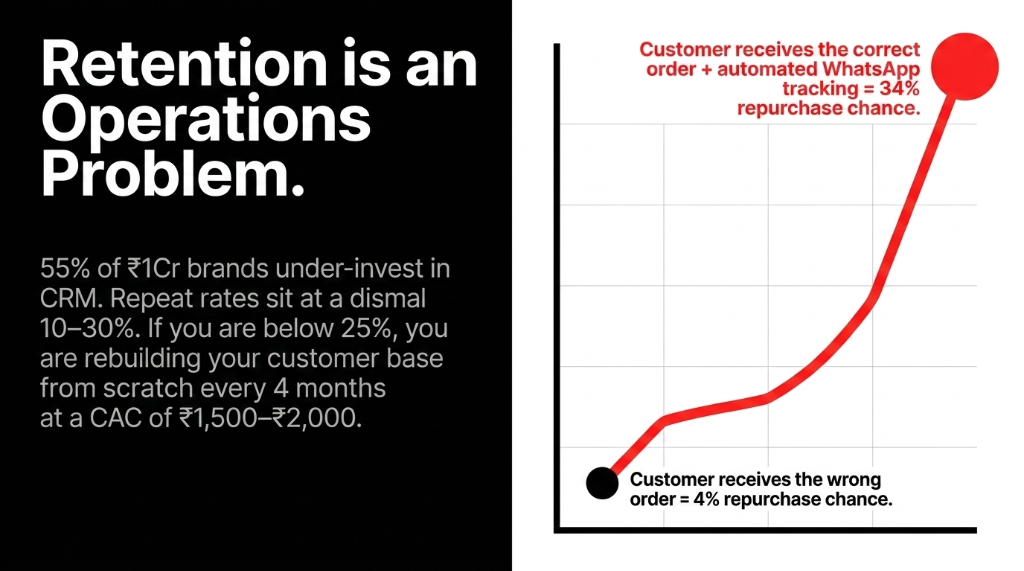
The fix isn't a fancy Klaviyo sequence (though set one up anyway). The fix is operational: make sure your post-purchase experience — delivery confirmation, product education, reorder reminders — is automated and accurate. A customer who receives a wrong order with no proactive communication has a 4% chance of repurchasing. A customer who receives the correct order with a delivery confirmation and a 7-day check-in WhatsApp has a 34% chance. That's not a marketing problem. That's an operations problem.
Frequently Asked Questions
At ₹1Cr revenue, do I need an ERP or can I manage with Shopify apps?
Shopify apps handle the front-end. They don't reconcile your returns, sync with your warehouse offline, or generate purchase orders automatically. At ₹1Cr with 300+ monthly orders, you need a back-end system that connects inventory, accounting, and logistics. Odoo does this for ₹2.5–6 lakh setup vs. ₹18L+ for traditional ERP.
How long does an Odoo implementation take for a D2C brand at this stage?
A standard D2C implementation covering inventory, order management, and Shopify integration takes 6–10 weeks. Custom returns workflows or multi-warehouse setups add 2–3 weeks. You're live in under 3 months — not 12, which is what legacy ERP vendors quote.
What's the realistic ROI in the first 90 days?
Based on our last 40 D2C implementations, brands recover ₹1.2–₹2.8 lakh in the first 90 days from plugged inventory leaks, reduced RTO losses, and reconciled return credits. Operational cost reduction adds another ₹40,000–₹80,000 per month by month 4.
What happens to our Shopify and QuickBooks data during migration?
We migrate it. All historical orders, SKU data, and accounting entries are imported into Odoo before go-live. You don't start from zero — and you keep QuickBooks read-only for 60 days post-migration as a fallback.
Our ops are fine right now. Why should we change anything?
Because every brand we've audited that said "our ops are fine" had a minimum of ₹8,000 per month in untracked losses. "Fine" usually means "I haven't looked closely enough." Book the 15-minute audit — if we don't find ₹10,000+ leaking per month, we'll tell you and send you away.
Stop Bleeding Cash on Ops Problems That Have a Known Fix
Book our free 15-Minute Operations Audit — we'll identify your single biggest operational leak in the first call. No pitch. No fluff.