
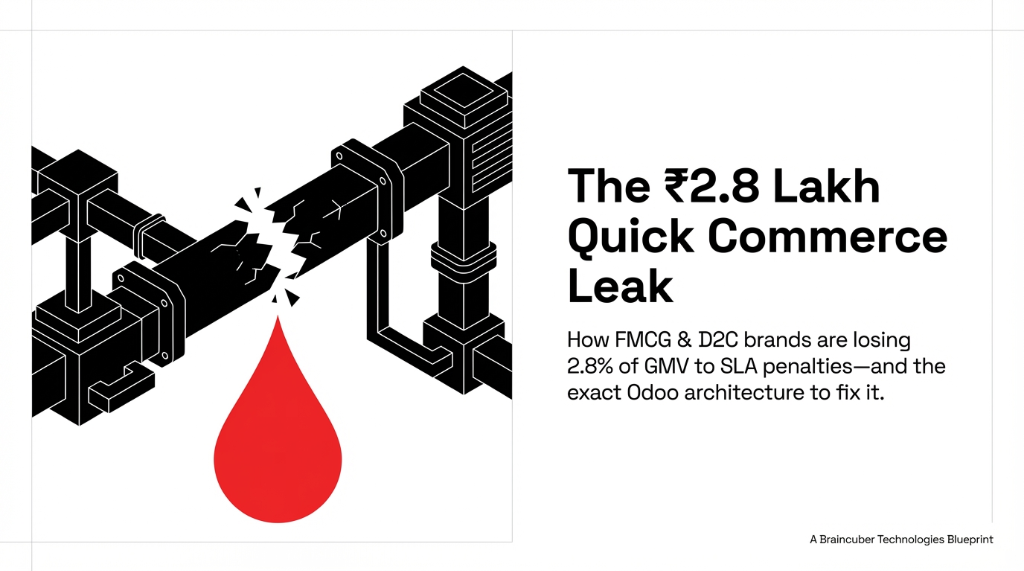
The ₹2.8 Lakh Problem Nobody Talks About
India’s quick commerce market hit $6–7 billion GMV in 2024 and is growing at 40% annually through 2030. Blinkit controls 46–50% of that market. Zepto holds 29%. Every serious D2C brand now has a presence on both.
But here is the dirty operational reality that no quick commerce keynote speaker will tell you:
Blinkit sends purchase orders via email.
A PDF or text email lands in your inbox. Someone on your team has to read it, decode it, manually create a sale order in your ERP, forward it to the warehouse, and then pray the picker finds the right SKU. When your warehouse guy types “MNGO-PKT-200” instead of “MNGO-PKT-200G” — two characters off — Odoo cannot match the SKU, the order fails silently, and 200 units of mango juice sit in your Central Warehouse instead of reaching Blinkit’s dark store in Bandra.
The Broken Data Pipeline
SLA Breach
You breach the delivery SLA. Blinkit deducts the penalty from your next payment. Average leakage: ₹2.8 lakh/month for a ₹1 crore brand.
Revenue Lost
That is 2.8% of revenue — gone, not because the product was unavailable, but because the data pipeline was broken.
Zepto: Same Chaos
Zepto also operates on a PO-email model with auto-forwarding. If your Gmail rule breaks — and Gmail rules break more often than anyone admits — you miss the PO entirely.
Why Your Current Setup Is Actively Failing You
Here is the controversial opinion nobody in a Blinkit seller webinar will say out loud: most mid-sized brands are not ready for quick commerce operationally, even when they are commercially approved.
Getting listed on Blinkit or Zepto is the easy part. What they do not help you build is the backend infrastructure to actually fulfill POs at speed and at scale.
1. SKU Mismatch Between Platform and ERP
Blinkit assigns its own internal item codes. Zepto has its own seller SKU codes. If your Odoo product catalog uses different codes (which it almost certainly does), every single order lands in a “Failed Orders” queue. You then manually match and push — adding 35–45 minutes per PO cycle.
2. No Real-Time Inventory Visibility at Dark Store Level
You might have 1,200 units in your Central Delhi warehouse. But Blinkit’s Gurugram dark store has 0 units and just sent you a PO for 400. Without Odoo pulling inventory from a multi-location warehouse view, your team is playing “guess which warehouse” every morning.
3. Zero Automation Between PO Email and Fulfillment
PO Email → Team Member Opens → Types into Excel → Sends to Warehouse on WhatsApp → Warehouse Picks → Manual Invoice Generation → Upload to Blinkit Portal. That is 7 human touchpoints for one purchase order. Seven chances for error, delay, or “I thought you did that.”
How the Odoo–Blinkit–Zepto Integration Actually Works
Let us get into the exact architecture. No fluff.
Step 1: Email Parsing and Automated PO Ingestion
Both Blinkit and Zepto deliver POs via email. The integration starts by setting up an email parser in Odoo that watches a dedicated inbox — say, quickcommerce@yourbrand.com — for incoming PO emails.
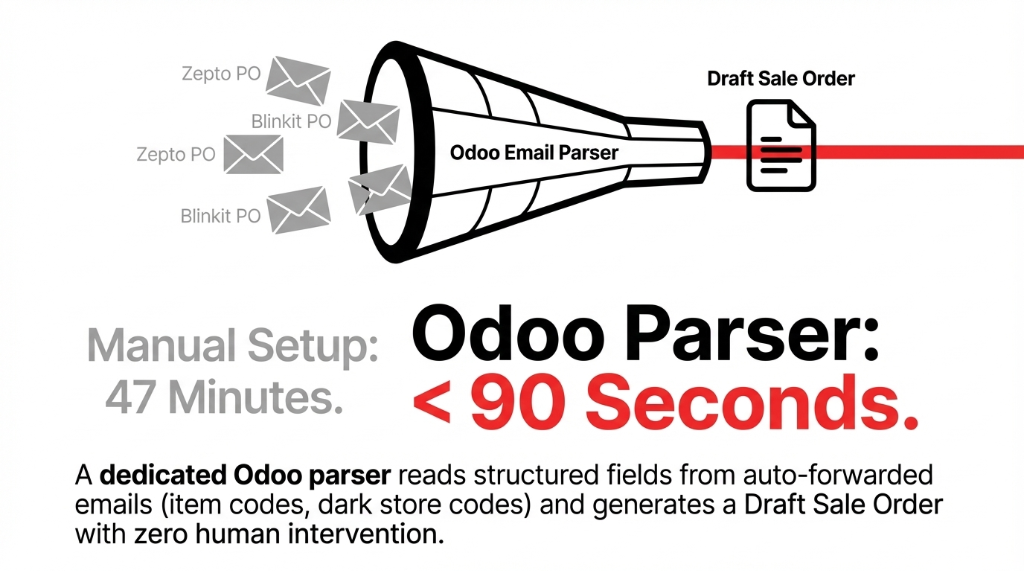
The parser reads structured fields from the PO: item codes, quantities, delivery windows, dark store location codes. It then creates a draft Sale Order in Odoo automatically — no human involved. This cuts the “PO received to Sale Order created” time from 47 minutes (manual) to under 90 seconds (automated).
Step 2: SKU Mapping Table in Odoo
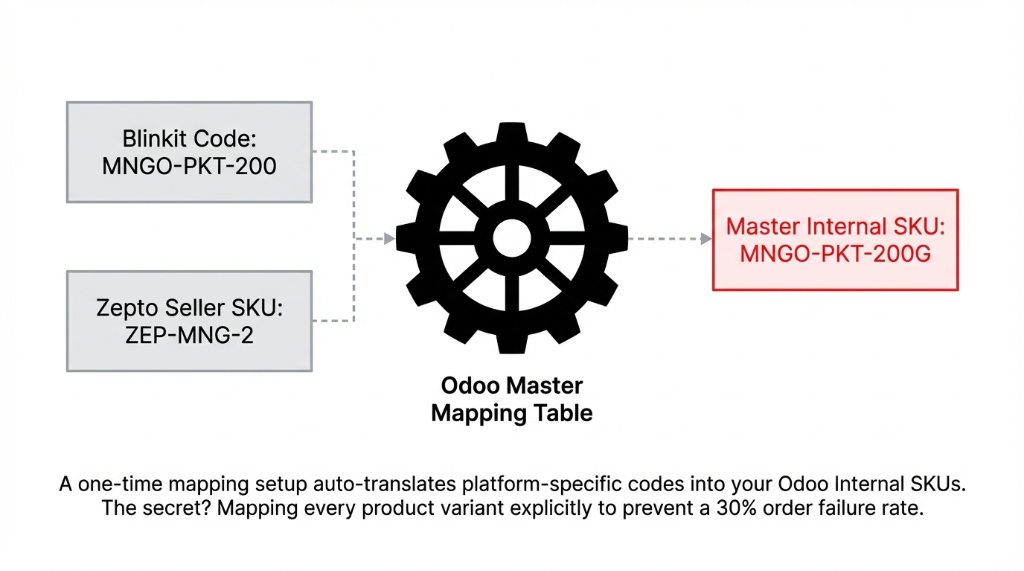
Before go-live, you build a cross-reference table inside Odoo that maps Blinkit Item Code and Zepto Seller SKU Code to your Odoo Internal SKU. This is a one-time setup that takes 3–4 hours per platform, not days.
The Insider Secret: Variant Mapping
If you have product variants (e.g., 200g vs. 500g pack of the same product), each variant needs its own mapping row. We have seen brands map the parent product but forget the variants — and then wonder why 30% of their orders are throwing errors.
Step 3: Multi-Location Inventory Allocation
Once the Sale Order is created, Odoo’s Inventory module automatically checks your configured warehouse locations — Central Warehouse, Regional Hub, or even consignment stock at a 3PL — and allocates inventory using FIFO or a custom route.
You configure “Quick Commerce Routes” in Odoo that give Blinkit/Zepto POs priority fulfillment over your direct-to-consumer Shopify orders during peak hours. Dark store replenishment never waits behind a batch of 50 individual D2C shipments.
Step 4: Real-Time Webhook Sync
Odoo’s REST API and webhook system fires an event the moment a Sale Order status changes. Configure it in under 2 minutes:
Your WMS gets pinged instantly when the Sale Order is confirmed. A picking order is generated automatically. No email. No WhatsApp. No “hey, did you see the Blinkit PO?”
Step 5: GST E-Invoice Generation
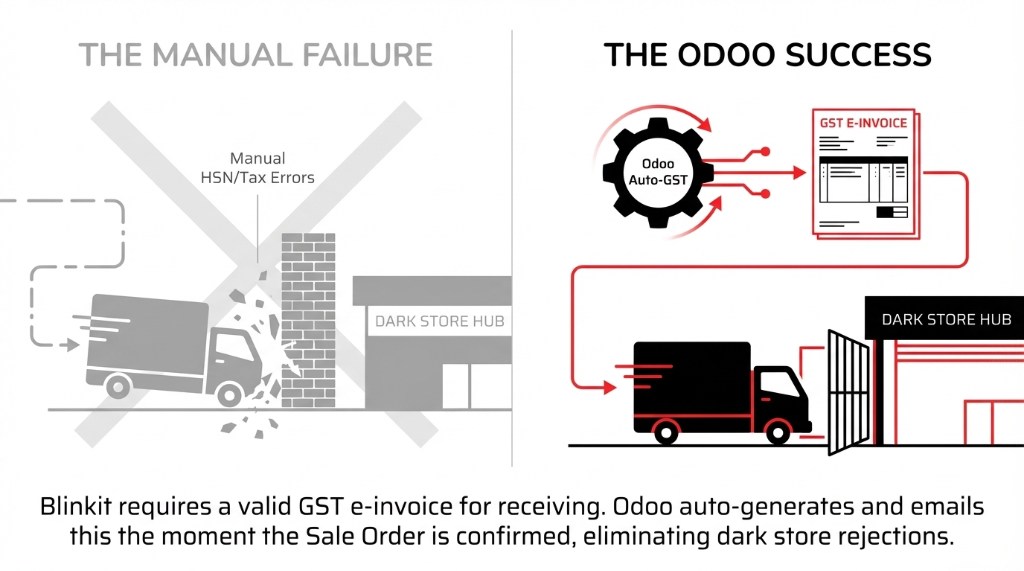
This one trips up 80% of brands and creates the worst delays. Blinkit requires a valid GST e-invoice before they accept goods at their dark store. With the integration, Odoo auto-generates the e-invoice the moment the Sale Order is confirmed — pulling GST numbers, HSN codes, and tax rates from the product master.
⚠ Real incident: (Yes, we have seen this happen. Twice. With the same client.) Goods sent out, rejected at the dark store because the invoice has a wrong HSN, and the truck drives back to the warehouse. No more.
Step 6: Goods Discrepancy and Returns Management
Here is what the “integration guide” articles always skip: what happens when Blinkit receives fewer units than you sent?
Dark store receiving is notoriously inconsistent. Blinkit might confirm 380 units received against your PO of 400. Without an integration, that 20-unit discrepancy sits unresolved until your accountant tries to reconcile the payment — usually 45 days later.
With Odoo, you configure a Goods Discrepancy Management flow: when the GRN comes back with a quantity variance, Odoo automatically creates a credit note for the 20 units, adjusts your inventory ledger, and flags it in your Accounts Receivable with a “pending resolution” tag. Your accountant sees it in real-time — not 45 days later.
What You Should Realistically Expect After Going Live
| Metric | Before Odoo | After Integration |
|---|---|---|
| PO processing time | 47 minutes per PO | Under 2 minutes per PO |
| SLA breach rate | 18.5% of POs | Under 3.1% (within 6 weeks) |
| Inventory reconciliation | 3 days per month | 4 hours per month |
| GST e-invoice errors | Recurring dark store rejections | Eliminated entirely (Week 1) |
| Monthly SLA penalty leakage | ₹2.8 lakh (avg.) | ₹2.4 lakh recovered in 60 days |
The SKU Master Warning
The brands that see results fastest are the ones that do the SKU master data cleanup upfront. If your Odoo product catalog has 400 SKUs and 60 of them have duplicate or inconsistent naming — and they do, we check every time — the integration will work at 85% efficiency until you fix the underlying data. We always run a data audit in Week 1 before touching a single API key.
The Implementation Reality: What It Takes
The 6-Week Go-Live Sequence
Week 1–2
Foundation. SKU master data audit + cleanup. Email parser setup and testing. Cross-reference mapping table built.
Week 3
Sandbox Testing. Sale Order auto-creation tested with real PO samples from Blinkit and Zepto. Webhook configuration for warehouse ping.
Week 4
Soft Launch. Go-live on one dark store / one city. Run parallel (manual + automated) for 7 days to catch edge cases.
Week 5–6
Full Rollout. All dark stores. E-invoice automation live. Discrepancy management workflow activated. Anyone telling you they can do this in 72 hours is running a connector that will break the moment Blinkit changes their PO email format — and they change it without notice.
The One Mistake That Derails Every Quick Commerce Integration
Everyone focuses on getting POs into Odoo. Nobody thinks about what happens at the other end: the dark store GRN.
When Blinkit’s dark store staff scans your goods in, they update their internal system. That update does not automatically flow back to your Odoo. You have to build or configure a GRN sync — either via Blinkit’s seller portal data export + Odoo import, or via a middleware webhook.
The Over-Shipment Trap
Without GRN sync, your Odoo thinks you have 400 fewer units in stock (because you shipped them) but you have not confirmed they have been received. Your available stock is understated, your replenishment triggers fire prematurely, and you end up sending a second PO fulfillment for stock that has not even been counted yet.
We have seen brands over-ship by ₹14,700 worth of goods in a single week due to this exact gap.
Stop Letting Blinkit Bill You for Your Own Inefficiency
You are not losing money because your product does not sell on quick commerce. You are losing money because the data pipeline between Blinkit’s PO email and your warehouse is held together by a Gmail forwarding rule and hope.
Every day you run manual PO processing on quick commerce, you are leaving ₹8,000–12,000 on the table. That is not a projection — it is what we have calculated across the last 11 quick commerce integrations we have delivered.
FAQ
Does Odoo have a native Blinkit or Zepto connector?
No. As of April 2026, neither Blinkit nor Zepto offers a native Odoo connector on the Odoo Apps Store. Integration is built via email parsers, REST API webhooks, and custom Python middleware. Braincuber builds this as a custom module tailored to your SKU catalog and PO format — typically delivered in 6 weeks.
Can this integration handle both Blinkit and Zepto simultaneously?
Yes. Both platforms use email-based PO delivery, so the same Odoo email parser handles both channels. You configure separate SKU mapping tables per platform. Odoo then manages fulfillment from a single inventory pool, auto-allocating to whichever platform’s PO arrives first based on your priority rules.
What happens if the PO email format changes?
It breaks the parser — temporarily. This is the biggest risk with any email-based integration. We build a “parse failure alert” that pings your operations team via Odoo’s internal notification system within 3 minutes of a failed parse. You can re-process manually while we push a format update, usually within 4 hours.
Will this work with Odoo Community or only Enterprise?
The core email parsing, SKU mapping, and Sale Order creation work on Odoo 16/17/18 Community. The full webhook module and multi-location inventory routing work better on Enterprise. Zepto’s Unicommerce integration, for context, is enterprise-only — Odoo gives you more flexibility at lower cost.
How much does the integration cost to build?
For a brand with 200–500 SKUs selling across 3–5 cities, a full Odoo–Blinkit–Zepto integration typically runs ₹1.8–3.2 lakh one-time build cost plus ₹18,000–25,000/month for support and maintenance. You will recover the build cost in SLA penalty savings within 60–75 days.
Your Gmail Inbox Has the Proof. Open It.
Book a free 15-Minute Operations Audit with Braincuber. We will identify your biggest quick commerce data leak in the first call — whether it is PO processing delays, SLA penalties, or GRN discrepancy gaps. No pitch. Just the number that is costing you money right now.