
What This Post Covers
▸ Why 400–1,200 active SKUs with variant explosions, bundles, and seasonal spikes break every spreadsheet
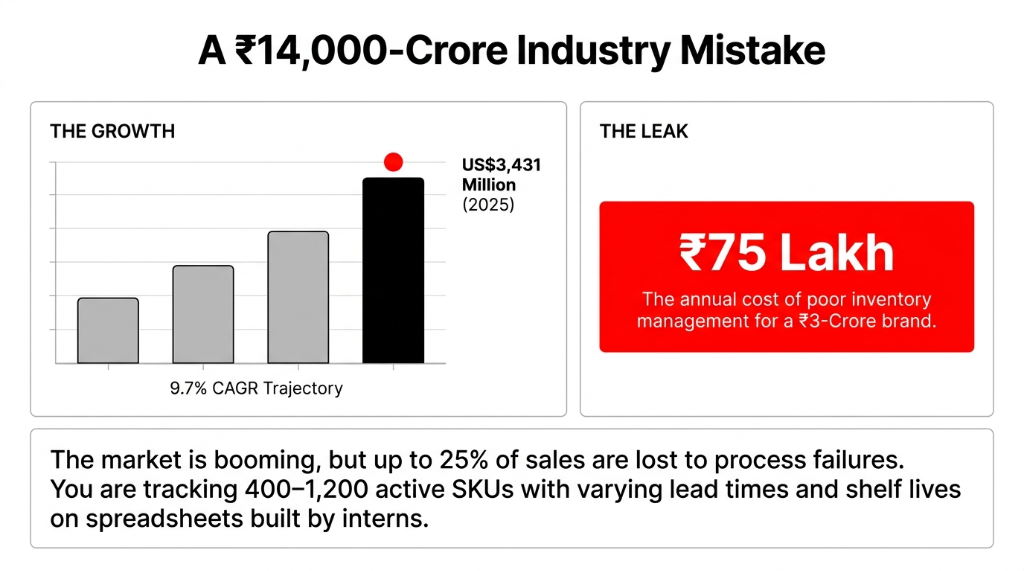
▸ The $13,095–$21,429/year you are losing to unreconciled returns, vendor payment errors, and deadstock
▸ How Odoo's BOM module reduced bundle fulfilment errors by 91% in 60 days
▸ Multi-channel routing that auto-shifts inventory priority between D2C, Amazon, and wholesale by season
▸ The honest 8–12 week implementation timeline — no sugarcoating
The Real Chaos Behind a Stationery D2C Brand
Your stationery D2C brand is growing — and that growth is quietly killing you. You launched with a passion for art supplies, notebooks, brush pens, and washi tapes. You built a Shopify store, ran some Instagram ads, and orders started rolling in. But somewhere between 500 and 5,000 orders a month, something broke. You do not know what broke. You just know your margins are shrinking and your warehouse guy is always confused.
This is not a cash flow problem. It is an operations problem. In our experience running ERP implementations for D2C brands across India, the UAE, and the UK, stationery and art supply brands have some of the most tangled back-end operations we have ever seen — primarily because their founders are creative people, not supply chain people. (No offense. It is actually why we love this space.)
The India Stationery, Crafts and Art Supplies e-commerce market generated $3,431 million in revenue in 2025, growing at 15–20% year-on-year. The India Art Stationery Market is projected to grow at a CAGR of 9.7% through 2029. This market is not small anymore. And running it on spreadsheets and three disconnected apps? That is a $1.67 billion industry mistake happening at the SKU level, every single day.
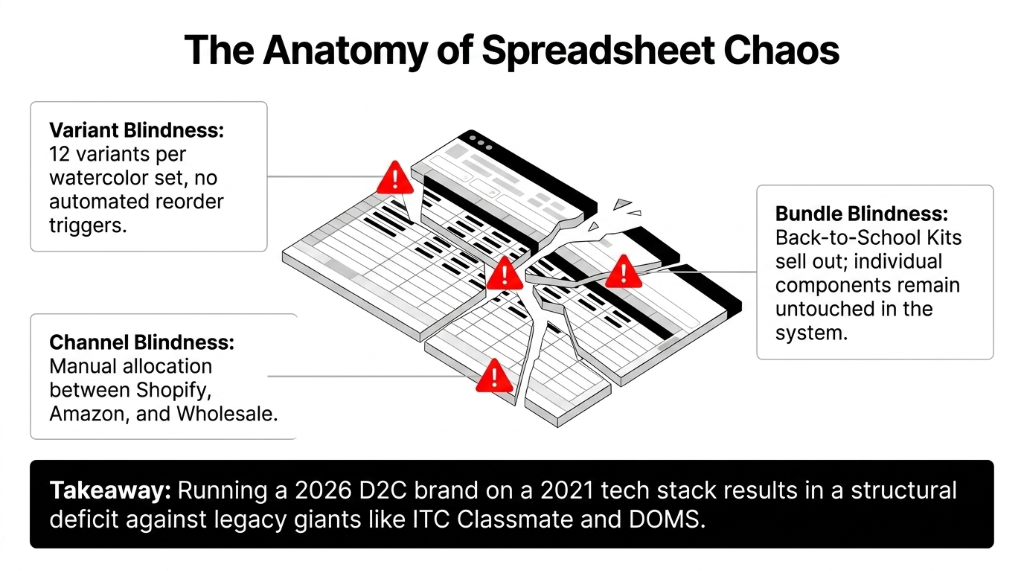
You have 400–1,200 active SKUs. Watercolor sets, individual pens, bundle kits, gifting sets, limited-edition art journals. Each has its own reorder point, vendor lead time, and shelf life consideration (yes — some art materials degrade). And you are tracking all of this in a Google Sheet with conditional formatting that your operations intern built six months ago and now nobody fully understands.
The Failure Loop We See Every Time
Shopify Says 47 Units
Your warehouse has 12. Six damaged, nine ghost-allocated to a wholesale order, twenty double-committed by a broken Zap.
37 Hours/Month Reconciling
Your ops team spends a full work-week every month just figuring out what is actually on the shelf.
Cancellation Emails
Customers get order confirmations followed by cancellations. NPS tanks. Shopify chargebacks pile up.
Why "Just Hire More People" Is the Wrong Answer
We hear this constantly: "We will just hire an inventory manager." Frankly, hiring more people to manage broken processes is not scaling — it is papering over a structural failure. A $595/month inventory manager working in a system without real-time multi-warehouse visibility and automated purchase order triggers will make the same mistakes your current team makes. Just slower, and with more emails.
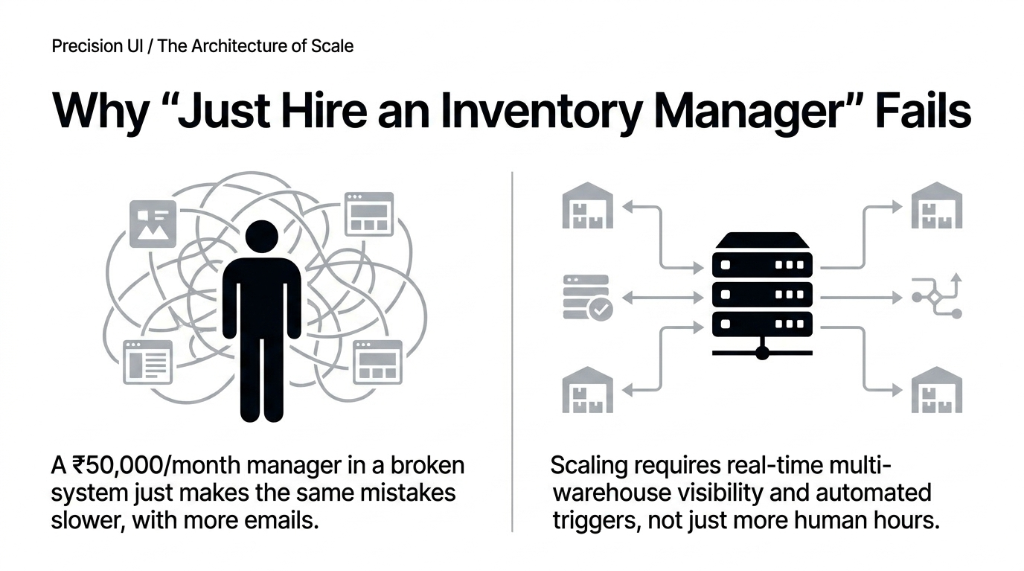
The stationery market in India is dominated by brands like ITC Classmate, DOMS Industries, Maped India, and Kokuyo Camlin. These are businesses with real supply chain infrastructure. As a D2C challenger brand trying to carve out a premium niche — your Brustro-quality art journals, your handcrafted washi collections, your curated brush pen subscription boxes — you cannot compete on logistics if you are running a 2021 tech stack in 2026.
The Uncomfortable Truth
The brands winning in the $59,524–$297,619 ARR range of India's stationery D2C space all did one thing early — they put an ERP system in place before they thought they needed one.
Where Odoo ERP Fixes the Stationery D2C Operation
We have implemented Odoo ERP for D2C brands across product categories from apparel to electronics, but stationery and art supplies present a specifically satisfying implementation challenge. Here is what we actually build:
SKU Variant Explosion: Finally Under Control
A single "watercolor set" can have 12 variants — 12-color, 24-color, 36-color, refill set, student grade, professional grade — each with its own supplier, MOQ, cost, and lead time. In Odoo, we build a product variant matrix that tracks all of this in one record. When the 24-color set drops below 83 units (your real reorder point, not a guess), the system auto-creates a draft purchase order to your vendor in Rajkot and flags your procurement manager.
Reorder Processing: 18 Minutes Down to Under 2
Automated reorder triggers cut per-SKU processing from 18 minutes to under 2 minutes — and eliminate the "we ran out again" situation that killed your Diwali gifting season last year.
Bundle and Kit Management That Does Not Break
This is where most stationery D2C brands bleed silently. You create a "Back-to-School Art Kit" bundle with 14 individual components. When 200 kits sell in 48 hours, your Shopify inventory shows those 200 kits gone — but has it deducted the 200 x 14 = 2,800 individual components from stock? Only if your Zap worked correctly. (It did not. It never does during a spike.)
Odoo's Bill of Materials module handles this natively. When a bundle order comes in through Shopify, Odoo's real-time kit fulfillment logic deducts each component instantly, triggers replenishment for any component that drops below threshold, and sends warehouse picklist instructions automatically. We integrated this for a D2C gifting brand and reduced bundle fulfilment errors by 91% in the first 60 days.
Multi-Channel Order Management Without the 3 AM Panic
If you sell on Shopify, Amazon, Flipkart, and have a wholesale arm (schools, corporates, gift shops), you are managing at least four order streams. Without a central ERP, you are hand-picking which channel gets stock when a product goes low. That is a decision that should never be made emotionally — it should be made by pre-configured channel priority rules.
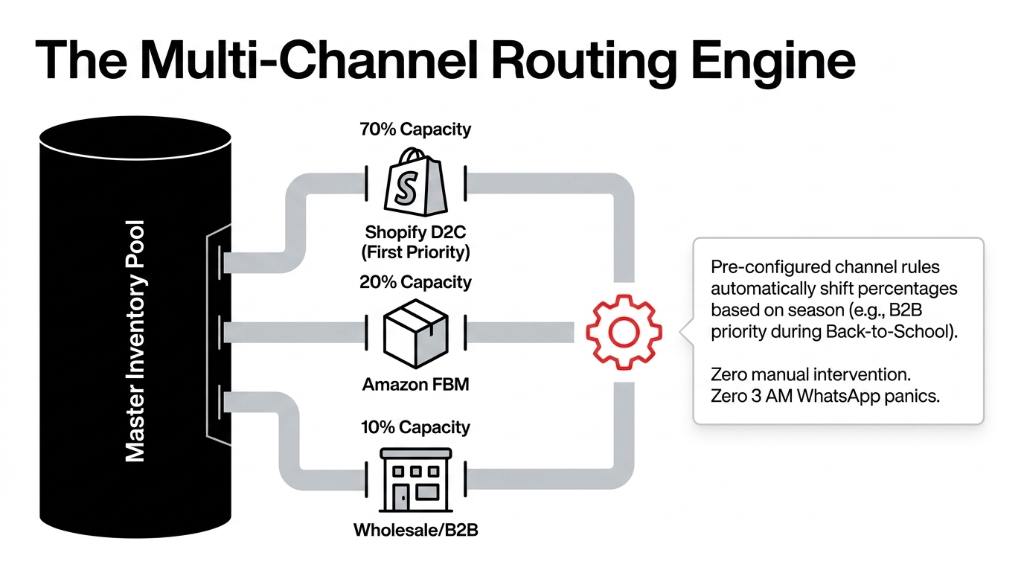
In Odoo, we set up multi-channel order routing with channel-level inventory reserves. Your Shopify D2C channel gets first priority on 70% of available stock. Amazon Fulfilled-by-Merchant gets 20%. The remaining 10% is reserved for B2B orders. These numbers are configurable and change automatically based on season rules. During the Back-to-School window (June–August), your school supply orders get priority. During Q4, your gifting bundles do. No manual intervention. No 3 AM WhatsApp messages to your warehouse team.
Financial Reality: What the P and L Actually Shows
$11,190 Per Quarter — Leaking Silently
Source: One of our India stationery D2C implementations. The brand was bleeding exactly $11,190 per quarter in unreconciled returns, incorrect vendor payments, and write-offs from expired/damaged stock.
Post Odoo Implementation
Returns processing: 3-day manual cycle down to 4-hour automated cycle. Vendor reconciliation moved to real-time. Write-offs dropped by 67% — the system now flags slow-moving stock at 90 days and auto-triggers a markdown or bundling recommendation before it hits the 180-day deadstock threshold.
The Implementation Reality: What Actually Happens
We are not going to tell you Odoo implementation is a 2-week plug-and-play. It is not. Here is the honest timeline for a stationery D2C brand with 400–800 SKUs:
| Weeks | Phase | What Actually Happens |
|---|---|---|
| 1–2 | Discovery + Data Audit | SKU master cleanup. (This is where we find the chaos — duplicate SKUs, orphaned variants, broken VLOOKUPs.) |
| 3–5 | Core Modules Live | Inventory, Purchase, Sales go live. Your team starts processing orders in Odoo for the first time. |
| 6–7 | Shopify + Channel Mapping | Bi-directional Shopify–Odoo integration with rate-limit handling. Amazon and Flipkart channel mapping configured. |
| 8 | Accounting Sync | We typically replace Tally or disconnect a broken QuickBooks setup here. GST e-invoicing goes live. |
| 9–10 | Training + Go-Live | Staff training, parallel run, full cutover. By Week 12, your ops team stops working weekends. |
The Braincuber team has 500+ completed projects and 4+ years of specialized ERP and AI implementation experience. We do not sell licenses. We build the system around how your brand actually works, not the other way around.
What You Should Demand from Any ERP Vendor
Not all ERP implementations are equal. Here is what a proper Odoo ERP setup for stationery D2C must include — and what you should reject if a vendor glosses over it:
Non-Negotiable ERP Requirements for Stationery D2C
Real-Time Bin-Level Tracking
Multi-warehouse visibility at the bin level — not just warehouse-level guessing.
Native Shopify + Marketplace Sync
Bi-directional with rate-limit handling. Shopify's API has a rate cap that kills sync during flash sales — demand your vendor addresses this.
Bundle/Kit BOM + Auto PO Triggers
Live component reservation when a kit sells. Automated purchase orders with vendor-specific lead time rules.
Demand Forecasting + Returns Automation
18 months of historical data, seasonality-adjusted (Back-to-School, Diwali, Valentine's). Vendor debit note automation for returns.
If any ERP vendor is selling you a "light package" without demand forecasting, returns automation, and GST e-invoicing integration — they are setting you up for a second implementation in 18 months.
Frequently Asked Questions
How long does Odoo ERP implementation take for a stationery D2C brand?
For a brand with 400–1,200 SKUs selling on 2–4 channels, a full Odoo implementation typically takes 8–12 weeks. The first 2 weeks are data cleanup and discovery. You will see operational improvement — faster order processing, fewer stock discrepancies — by Week 10 at the latest.
What does ERP for stationery D2C cost in India?
A proper Odoo ERP implementation for a D2C stationery brand typically ranges from $4,167–$9,524 for implementation, depending on customization depth and number of integrations. Odoo's subscription starts at approximately $17.86–$23.81/user/month. Avoid vendors quoting under $1,786 — they are selling a template, not a solution.
Can Odoo handle seasonal demand spikes like Back-to-School or Diwali gifting?
Yes — and this is one of its strongest use cases for stationery brands. Odoo's forecasting module analyzes your historical order data and automatically adjusts reorder points and safety stock levels before peak seasons. You define the season windows; the system prepares your inventory 6–8 weeks in advance so you stop running out of your top 20 SKUs during peak.
What happens to our existing data in Tally or QuickBooks during migration?
We extract and clean your historical data before migration — typically 2–3 years of sales history, open POs, and vendor master data. Nothing gets lost. The process takes 5–7 working days. We run a parallel period where both systems are live before cutting over, so your finance team has zero disruption to month-end close.
Does Braincuber provide support after the ERP goes live?
Yes. We provide ongoing Odoo support, training, and module upgrades post go-live. We also offer AI-layer enhancements — such as automated demand forecasting agents and AI-powered customer support bots for your Shopify store — as your brand scales past $119,048 ARR.
Stop Losing $13,095–$21,429 a Year to Broken Ops
Inventory errors, bundle mismatches, and unreconciled returns are eating your margins every single month. Book your free 15-Minute Operations Audit with Braincuber. We will find your biggest operational leak in the first call — no fluff, no sales pitch, just an honest look at where your money is going.
Do not let broken ops slow down a brand worth building.