
What This Post Covers
▸ The $809–$1,964/month you are losing to bad inventory management alone
▸ Why NetSuite at $80,000–$200,000 will kill your cash flow before it fixes your ops
▸ FEFO enforcement that reduced expiry write-offs by 89% in 60 days
▸ Real-time Shopify sync that eliminated flash-sale overselling and refund nightmares
▸ 6–8 week implementation timeline — the honest version
The Real Cost of Running a Pet Food D2C on Spreadsheets
Pet food has a shelf life. Dog food, cat kibble, freeze-dried treats, cold-pressed nutrition — every SKU has an expiry date. When your team is tracking batches in Excel, they are not tracking first-in-first-out at the batch level. They are just guessing.
And that is before you count the stockouts. If even 5–7 customers per week cannot find a product because your Shopify inventory count has not synced with your actual warehouse, and their average cart value is $17.86 — you are losing $500–$714 in monthly revenue. Invisibly. Silently. While you are busy running ads.
The Invisible Monthly Bleed
Expiry Write-Offs
$2,226 in a single quarter from one brand. Warehouse pulling by "looks fresh enough" instead of batch date.
Stockout Revenue Loss
$500–$714/month vanishing because Shopify inventory does not match warehouse reality.
Annual Operations Drain
$9,714–$23,571 per year — not to competition, not to bad products. To bad operations.
Why Every "Standard Fix" Fails Pet Food Brands
Most founders try one of three things when the ops pain starts:
"Just Hire More People"
Bloating, not scaling. Three people managing the same broken process with three sets of conflicting spreadsheets.
"Just Add Another SaaS Tool"
Suddenly you have got Shopify for orders, Tally for accounting, a separate WMS, QuickBooks for payables, and Klaviyo for email — none of which talk to each other in real time.
"Just Buy a Generic ERP"
And then realize it has zero concept of batch management, expiry tracking, or FSSAI-compliant labelling for pet nutrition products.
Here is the controversial opinion: NetSuite will kill your cash flow before it fixes your ops. Implementation alone runs $80,000–$200,000 for a mid-market deployment, and it is built for enterprises with full-time IT teams. Not for a 30-person pet care brand trying to scale from $595,238 to $2.38M.
India's pet food market is growing from $773.7 million in 2025 to $1.46 billion by 2032 at a CAGR of 9.6%. D2C channels are leading this charge. The window to build operational infrastructure is right now — because your competitors are doing it.
What Odoo ERP Actually Solves for Pet Food D2C Brands
We are not talking about a flashy dashboard. We are talking about fixing the exact things that are bleeding you.
Batch and Lot Tracking — Down to the Gram
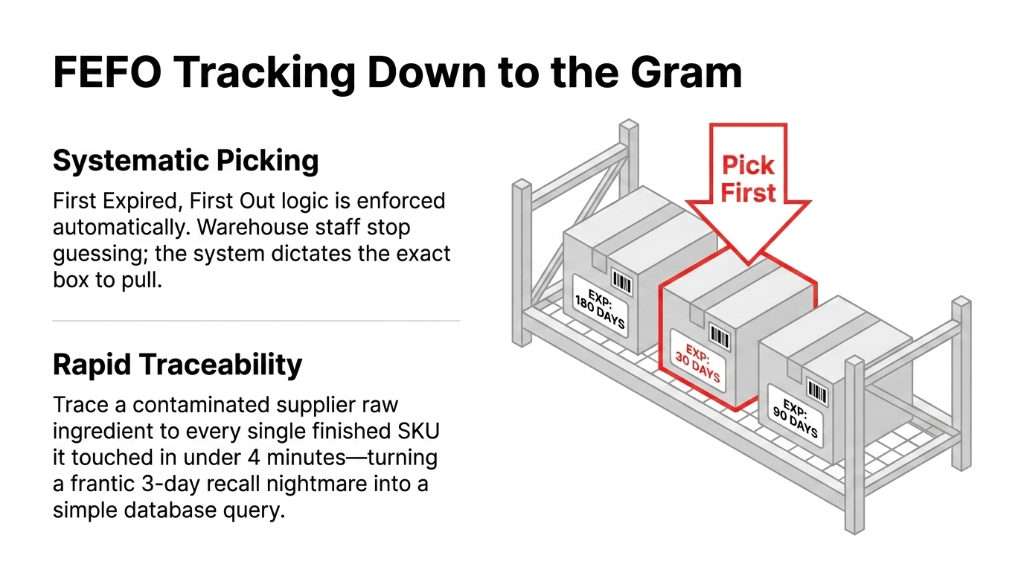
Every production run gets a batch number in Odoo. When you receive raw ingredients — chicken meal, omega supplements, grain — they are tagged to a vendor lot. If a supplier sends you a contaminated batch, you can trace every finished SKU it went into in under 4 minutes and trigger a recall. Without Odoo, that same exercise takes 3 days, two frantic calls to your co-packer, and a lot of guesswork.
Expiry Date Management That Actually Works
Odoo's inventory module enforces FEFO (First Expired, First Out) picking rules automatically. Your warehouse team does not decide. The system decides. Products expiring in 30 days get flagged for promotion or bundling. Products expiring in 7 days get a warehouse alert. No more $2,226 write-offs.
Shopify–Odoo Real-Time Sync (No API Lag on Sale Days)
This is the insider detail nobody talks about: Shopify's native inventory API can lag by 2–4 minutes during high-traffic events. On a flash sale or festive campaign (Diwali pet gifting is real), that lag means you are overselling products you do not have — and then issuing refunds that cost you payment gateway charges, Shopify fees, and customer trust.
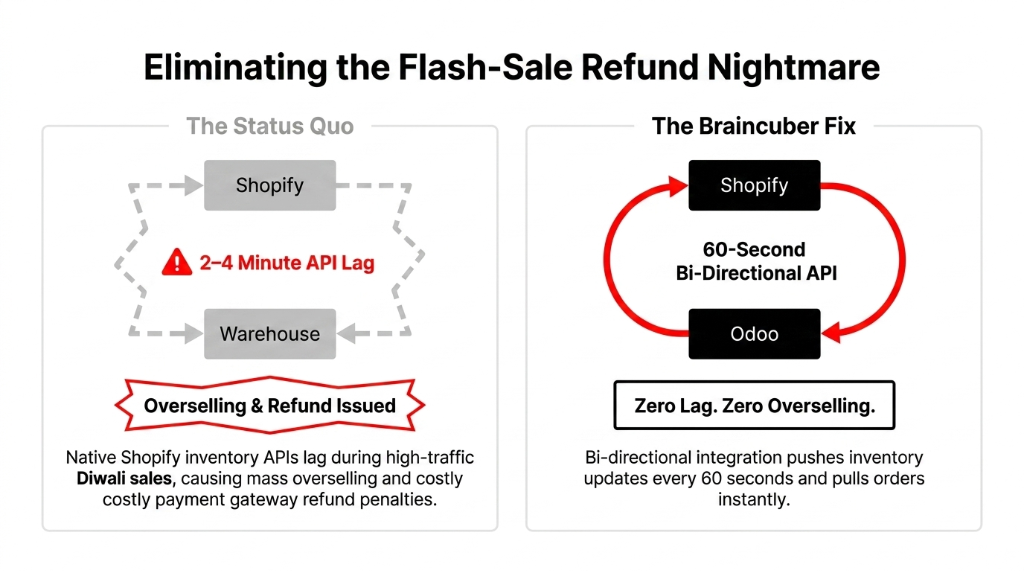
We integrate Odoo with Shopify using a bi-directional sync that pushes inventory updates every 60 seconds and pulls orders in real time. The result: zero overselling, zero refund nightmares.
Recipe and Formulation Management
Pet food is not fashion retail. Your SKUs have Bills of Materials (BoM). A 1kg bag of grain-free salmon kibble is made from a specific recipe — and that recipe changes if a supplier substitutes one ingredient. Odoo's manufacturing module tracks formulation versions, flags recipe deviations, and ties every batch to the exact BoM used. That is FSSAI-audit-ready documentation — without printing a single report manually.
Multi-Channel Order Management — One Screen
Your orders are coming from Shopify, Amazon, Flipkart, Blinkit, your own app, and WhatsApp Business. Right now, someone on your team is copy-pasting orders from 4 platforms into a dispatch sheet. Every manual entry is a potential $5.95 error — wrong SKU, wrong quantity, wrong address.
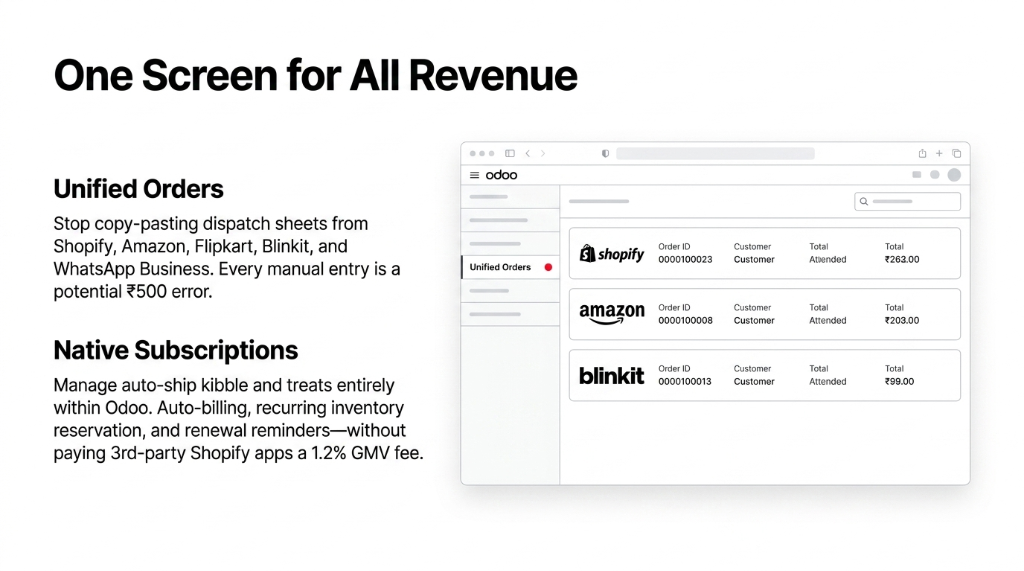
Odoo consolidates all channels into a single order management view. Every order, every channel, every fulfillment status — one screen. We have seen brands cut order processing time from 18 minutes per order to under 3 minutes after go-live.
Subscription Order Management
India's pet food D2C market is moving toward subscription models — monthly auto-ship of kibble, treats, and supplements. Odoo handles subscription billing, recurring inventory reservation, auto-invoicing, and renewal reminders natively. No third-party subscription app that charges you 1.2% of GMV. Keep your Shopify storefront — let Odoo handle the backend.
The Numbers You Should Actually Expect
Real Client Results ($238,095–$1.78M ARR)
Expiry Write-Offs
Reduced by 89% in the first 60 days after FEFO picking rules go live
Order Processing
Down from 18 min to 2.7 min per order with unified channel management
Stockouts
Dropped from 11/month to 1–2/month within the first quarter
Refund Rate
Dropped by 34% once real-time Shopify sync eliminated overselling. One brand recovering $279/month in previously untracked raw material wastage.
What Implementation Actually Looks Like (No Sugarcoating)
| Weeks | Phase | What Actually Happens |
|---|---|---|
| 1–2 | Data Migration | Current inventory, SKU master, vendor list, and customer data move into Odoo. (Yes, cleaning your Excel files will take longer than you think.) |
| 3–4 | Integrations + Config | Shopify/Amazon/Flipkart integrations configured and tested. Batch and lot tracking rules set up. BoMs for your top 20 SKUs built. |
| 5–6 | Parallel Run | Your team operates both systems simultaneously to catch gaps. This is where most brands discover their data was dirtier than they thought. |
| 7–8 | Go-Live | Full handover. Your team is trained on exactly what they need — not a 3-day generic ERP training. By week 9, your ops team stops messaging you on Sunday nights about stock discrepancies. |
Total timeline: 6–8 weeks for a brand doing $11,905–$119,048/month in revenue. The first two weeks are painful. Data hygiene is ugly. But it pays for itself before the quarter ends. Already running an Odoo implementation? Adding pet food batch modules takes 2–3 weeks on an existing instance.
The India Pet Care D2C Opportunity Is Real — But Only If You Are Built for It
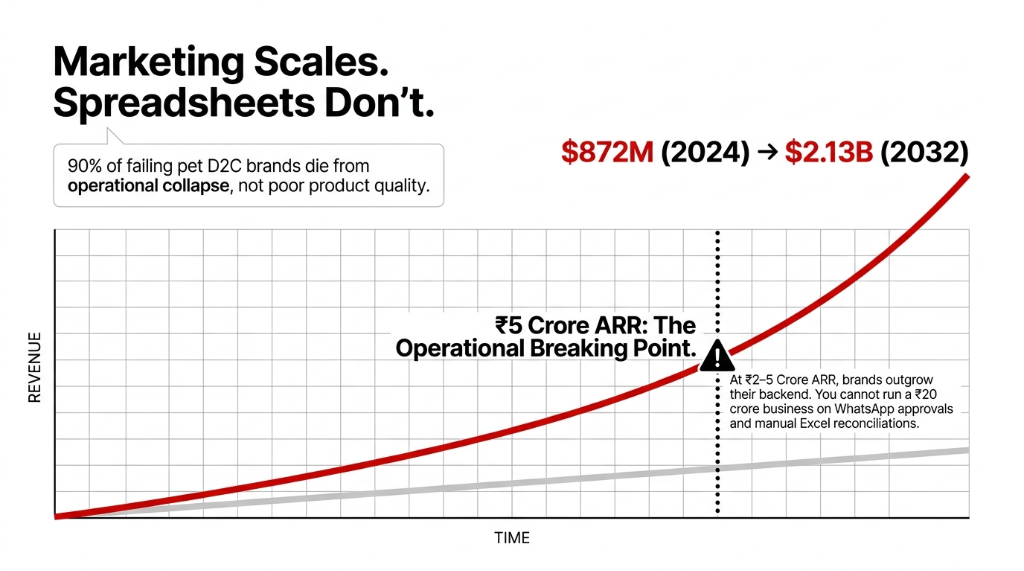
India's pet food market hit $872 million in 2024 and is headed to $2.13 billion by 2032. The D2C channel is growing faster than traditional retail — urban pet parents are buying premium, subscription-based nutrition online.
But here is the brutal truth: 90% of pet D2C brands that fail in India do not fail because of bad products. They fail because their ops could not handle scale.
You cannot run a $2.38M business on WhatsApp approvals and monthly Excel reconciliation. At $595,238 ARR, your ops complexity has multiplied 5x — but your systems have not. That gap is where brands die.
Frequently Asked Questions
How long does Odoo ERP implementation take for a pet food D2C brand?
For brands doing $11,905–$119,048/month in revenue, a standard implementation takes 6–8 weeks. This includes data migration, Shopify/marketplace integration, batch and expiry tracking setup, and team training. Brands with cleaner data and fewer SKUs (under 200) can go live in 5 weeks.
What does ERP for pet food D2C actually cost?
Odoo implementation for a D2C pet food brand typically runs between $4,167 to $14,286 depending on integrations, custom modules, and SKU complexity. Ongoing annual licensing for Odoo Enterprise is significantly lower than NetSuite or SAP — and does not require a dedicated IT team.
Can Odoo handle FSSAI compliance for pet food labelling?
Yes. Odoo's manufacturing module tracks every batch's ingredient composition, supplier lot numbers, and production dates — all required for FSSAI audit trails. You can generate batch traceability reports on demand, reducing audit prep from 2–3 days to under 30 minutes.
Will Odoo sync with our existing Shopify store without breaking it?
The Shopify–Odoo integration is bi-directional and non-destructive. Orders pull into Odoo automatically, inventory updates push back to Shopify in near real-time. Your Shopify setup stays intact; Odoo becomes the backend brain.
What happens to our current Tally or QuickBooks data during migration?
Historical financial data is exported, cleaned, and imported into Odoo's accounting module. Chart of accounts, vendor master, and outstanding payables/receivables all migrate. Takes 5–7 business days, and your accountant gets a 2-hour walkthrough after go-live.
Do Not Let Bad Operations Kill a Great Product
Book our free 15-Minute Operations Audit — we will identify your single biggest ops leak in the first call. No pitch deck, no fluff. Brands that built the backend early are the ones still standing at $5.95M. The ones who said "we will fix ops later" are still firefighting at $357,143.
Later is right now.