
What This Post Covers
▸ Why certification expiry is invisible until it becomes a crisis — and what that costs
▸ The "just hire more QA staff" trap that multiplies chaos instead of fixing it
▸ How Odoo enforces organic segregation rules, batch traceability, and 47-day advance expiry alerts
▸ Batch recall time: from 4–6 hours to under 12 minutes
▸ 11–14 week implementation reality — no fairy tales
The Certification Chaos Nobody Talks About
Let us get specific about what "certification management" actually looks like inside a growing organic food brand operating without ERP.
You have an NPOP (National Programme for Organic Production) certificate for your raw turmeric supplier — valid until March 2026. Your PGS-India certificate for your farm cluster expires in August. You export to Germany, so you also need EU Organic Regulation 2018/848 compliance. Your US distribution partner needs USDA NOP documentation updated quarterly.
Now multiply that by 12 suppliers.
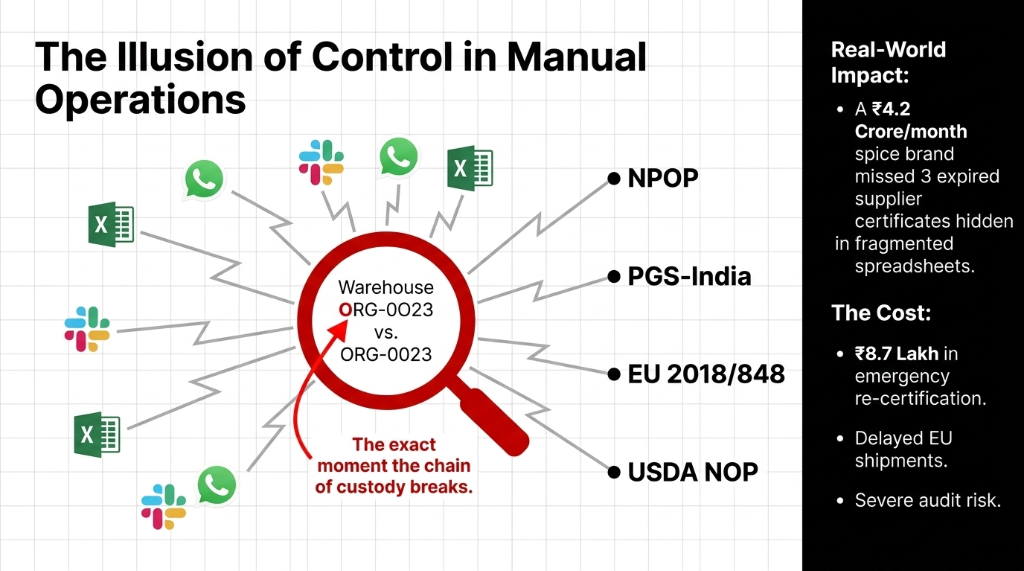
Where does your ops team track all of this? In a shared Excel file that three different people have edited, with a naming convention nobody follows. We have walked into this exact setup in 9 out of our last 14 food brand implementations.
Real Client Damage
Brand: Certified organic spice brand, $500,000/month revenue
Gap found: 3 expired supplier certificates nobody knew about
Consequence: EU export license at risk
Cost: $10,357 in emergency re-certification fees + delayed shipments
The deeper problem: certification expiry is invisible until it is a crisis. Without automated alerts, your QA team discovers the problem after the batch has shipped.
India's organic food market is growing at a 22% CAGR and is projected to hit $11.03 billion by 2034. The government launched TraceNet 2.0 — a digital platform for organic certification and traceability — specifically because manual tracking was destroying India's organic export credibility. If the government is building a digital backbone for organic traceability, your operations need to match that standard. Or you get flagged.
Why Your "Just Add More Staff" Strategy Is Failing
Here is the opinion that will make your HR department uncomfortable: hiring a third QA executive to manage batch paperwork is not a compliance strategy. It is an expense strategy.
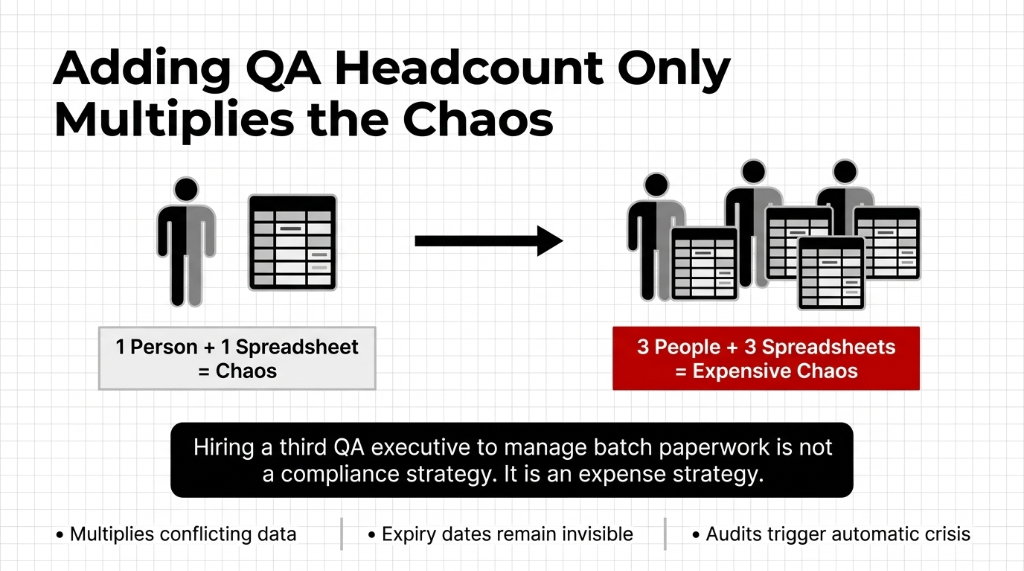
We constantly see brands scaling from $238,095 to $1.43M ARR think the answer to operational chaos is headcount. So they hire. Now they have three people managing the same broken process — just with three sets of conflicting spreadsheets instead of one.
The Real Problem Is Architectural
Organic food compliance requires end-to-end lot-level traceability — every gram of raw material entering your facility must be linked to a supplier certificate, a quality test result, a production batch, and a customer delivery record.
That chain of custody cannot be maintained in Excel. The moment your warehouse guy types batch code "ORG-0O23" instead of "ORG-0023" (a zero vs. the letter O), you have broken the chain. And now you cannot trace which 400 units of finished product that bad batch ended up in.
One typo. 400 units unaccounted for. Audit failed.
Most ERP consultants will not tell you this next part: generic ERP systems also fail at organic compliance. A standard Tally or even a basic SAP B1 implementation without food-specific batch modules will give you inventory tracking, but it will not enforce organic segregation rules. It will not flag when a conventional ingredient batch gets co-located with an organic batch. It will not block a production order from starting if the supplier's NPOP certificate is expired.
These are not features. These are non-negotiable compliance controls.
How Odoo ERP Actually Fixes This — Step by Step
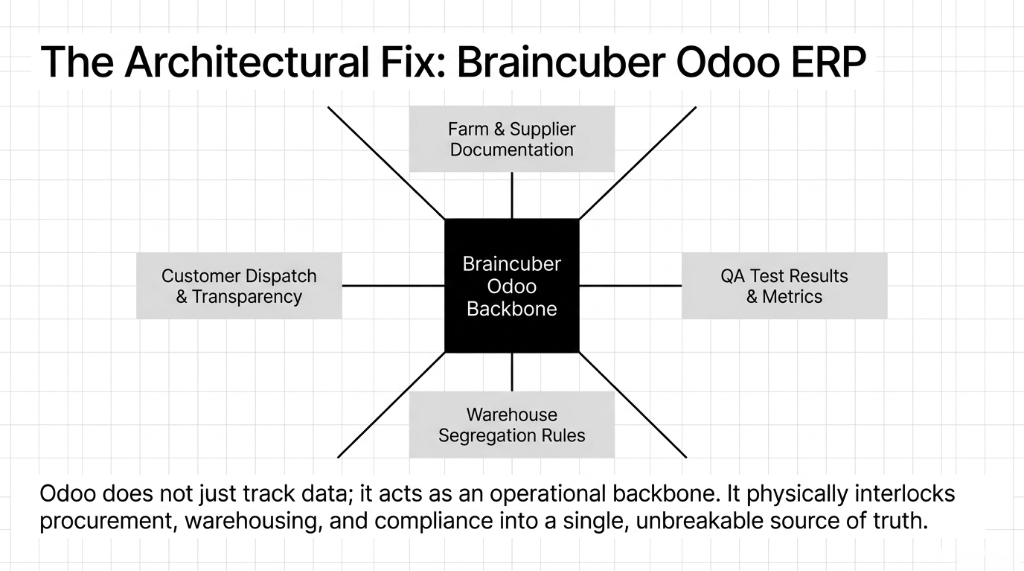
This is where ERP for organic food brands stops being theoretical and starts being operational.
1. Automated Certification Expiry Tracking
In Odoo's Purchase and Inventory modules, every supplier record carries an attached certification document with an expiry date. We configure automated alerts to trigger 47 days before expiry — not 7 days, not the day it lapses. Forty-seven days gives your procurement team enough time to request updated documents, run supplier audits if needed, and block purchase orders if the certificate is not renewed.
No more WhatsApp reminders. No more "I thought Priya was tracking that."
2. Batch-Level Traceability from Farm to Customer
Every inbound raw material in Odoo gets assigned a lot/batch number at the goods receipt stage — automatically linked to the supplier's certification document (NPOP/PGS/EU Organic/USDA NOP), the quality control test result (moisture, pesticide residue, heavy metals), the date of receipt, storage location, and the purchase order it came from.
When that raw material moves into production, Odoo tracks the lot through every transformation — blending, grinding, packaging, labelling. The finished product batch inherits the full input history. When an auditor walks in and asks you to prove that the turmeric in batch FG-2204 came from a certified organic source, you pull it up in 90 seconds. Not 3 hours. Not "let me call my warehouse manager."
3. Organic Segregation Controls
This is the insider detail most ERP vendors will not tell you upfront. Odoo can be configured to enforce physical location segregation at the warehouse level for organic vs. non-organic batches. If your brand runs both certified organic and conventional product lines (a common reality for brands transitioning their portfolio), Odoo's lot management rules prevent mixing at the storage, production, and dispatch stages.
An operator cannot physically assign a conventional batch to an organic production order — the system blocks it and generates a deviation alert. That is not a feature. That is how properly integrated ERP works.
4. QR-Code Linked Batch Transparency
Here is where the compliance tool becomes a marketing asset. We have implemented QR-coded batch labels for 3 of our organic food clients — scanning the QR code shows the end consumer exactly which certified farm the ingredient came from, the test results, and the certification body.
Consumers are now paying a premium of 7–20% for products with provable organic authenticity. That QR code on your packaging is no longer optional; it is a conversion tool.
The Results You Should Actually Expect
Post-Implementation Numbers (Real Clients)
Certification Lapses
Dropped to zero incidents within 60 days of go-live. 47-day advance alerts killed the surprise factor.
Batch Recall Time
From 4–6 hours across spreadsheets to under 12 minutes. One click, full traceability.
Export Doc Prep
EU and US buyer documentation shrank from 3.5 days to under 4 hours. Odoo generates the chain-of-custody report automatically.
QA Headcount Savings
Client: Organic spice brand, Hyderabad
Before: 11 active suppliers, 4 certificates expired or missing (67% compliance)
After: 100% supplier certificates current and accessible on-demand at next inspection
Annual QA headcount savings: $17,024 (replaced 2 manual tracking roles)
(Yes, that 67% figure came from a real pre-implementation audit we conducted. They had 11 active suppliers. 4 certificates were expired or missing.)
What the First 90 Days Actually Look Like
We will be straight with you about timelines because most ERP vendors quote 3 months and deliver in 7. For an organic food brand with 10–30 SKUs, 8–15 active suppliers, and 2 production lines, a properly scoped Odoo implementation takes 11–14 weeks:
| Weeks | Phase | What Actually Happens |
|---|---|---|
| 1–3 | Process Mapping | We document every certification type you carry, every supplier document requirement, and every batch touchpoint from inbound receiving to outbound dispatch. |
| 4–7 | Odoo Configuration | Lot/batch rules, certification expiry workflows, warehouse segregation zones, quality checkpoint triggers. |
| 8–10 | Data Migration | Bringing in your supplier master, existing certification documents, and historical batch records. Yes, even from your Excel chaos. |
| 11–14 | UAT + Go-Live | Staff training, parallel-run period, go-live. Your warehouse team will need 3–4 weeks post-launch to stop defaulting to WhatsApp for batch queries. |
What gets easier immediately after go-live: supplier certificate visibility (you will see every expiry date on one screen on Day 1), and batch creation — no more manual lot assignment, the system generates it at goods receipt.
The Cost of Doing Nothing
India's organic food sector is heading toward $11 billion. Food safety authorities are auditing more aggressively than ever. TraceNet 2.0 is now the government's digital benchmark for organic traceability.
Brands that do not build a digital operations backbone for certification and batch tracking in the next 18 months will face two outcomes: they fail an audit and lose their certification, or they get acquired by a larger player who already has the infrastructure and pays them a distress valuation.
Neither is a good exit. NetSuite starts at $36,000/year in licensing alone before implementation. Odoo's enterprise licensing plus a properly scoped Braincuber implementation for a brand at $357,000–$1.19M ARR runs a fraction of that — with full ROI achievable in under 9 months. Already thinking about upgrading your inventory management? Start here.
Frequently Asked Questions
Can Odoo ERP manage both NPOP and EU Organic certifications for the same supplier?
Yes. Odoo's supplier certification module supports multiple certification types per vendor, each with its own document attachment, expiry date, and alert workflow. We configure separate compliance tracks for NPOP, PGS-India, EU Organic (2018/848), and USDA NOP within the same supplier record — no duplication, no manual cross-checking.
How long does a batch recall take with Odoo vs. without ERP?
With Odoo's full lot traceability configured, isolating an affected batch — identifying every customer delivery, every production input, and every storage location — takes under 12 minutes. Without ERP, the same exercise typically takes 4–6 hours across spreadsheets and warehouse records, during which affected product continues to ship.
Does ERP for organic food brands help with food safety inspections?
Directly. Inspectors require batch-level traceability, supplier documentation, and quality test records accessible on demand. Odoo stores all three linked to each lot number — inspectors get a single audit trail printout covering the full supply chain, which satisfies the "one step forward, one step back" traceability protocol.
What happens to our existing certification documents during migration?
We digitize and import all existing supplier certificates, test reports, and batch records into Odoo during the data migration phase (weeks 8–10). Documents are indexed by supplier, certification type, and expiry date. Nothing is lost, and historical batch records remain searchable.
Is Odoo ERP affordable for a mid-size organic food brand?
Yes — and it is the only ERP we recommend at this scale. NetSuite starts at $36,000/year in licensing alone. Odoo's community edition is open-source; enterprise licensing plus a Braincuber implementation for a brand at $357,000–$1.19M ARR typically runs a fraction of that, with full ROI achievable in under 9 months through reduced compliance risk, faster documentation, and headcount efficiency.
Stop Bleeding Cash on Certification Gaps
Book our free 15-Minute Operations Audit. We will map your biggest organic compliance risk in the first call. If we cannot find at least one expired certificate or one broken batch chain, we will say so.
Open your supplier certification folder right now. If any document is older than 11 months, you already know you need this call.