
What This Post Covers
▸ The $1,690–$4,523/month you are bleeding on overselling, missed custom specs, and raw material wastage
▸ Why your "Shopify + Shiprocket + Excel" stack is a $25,476/year revenue leak
▸ How configurable BOMs cut custom order processing from 18 minutes to under 3 minutes
▸ The Shopify API lag that causes 30–50 oversold orders during every flash sale
▸ India-specific GST and artisan vendor fixes most ERPs ignore completely
The Custom Order Chaos No One Warns You About
Here is what actually happens at a $9,523/year home decor D2C brand. A customer orders a sofa. Your sales rep notes the specs in one place. Your warehouse reads a different version. Your fabric vendor hears a third version over a voice note. And the production manager? He has his own spreadsheet entirely.
When the order ships wrong — and it will ship wrong — that one-star review costs you $1,476 in lost lifetime value. That is what a returning home decor customer is worth over 3 years. Not our number. That is math from tracking 40 D2C implementations.
An ERP for home decor D2C — specifically Odoo — solves this with a configurable product module where every custom attribute (size, material, colour, finish, engraving) lives on the order itself, pushes automatically to the production work order, and triggers the correct BOM for raw material deduction. No voice notes. No PDF handoffs. No "I thought you meant the other walnut."
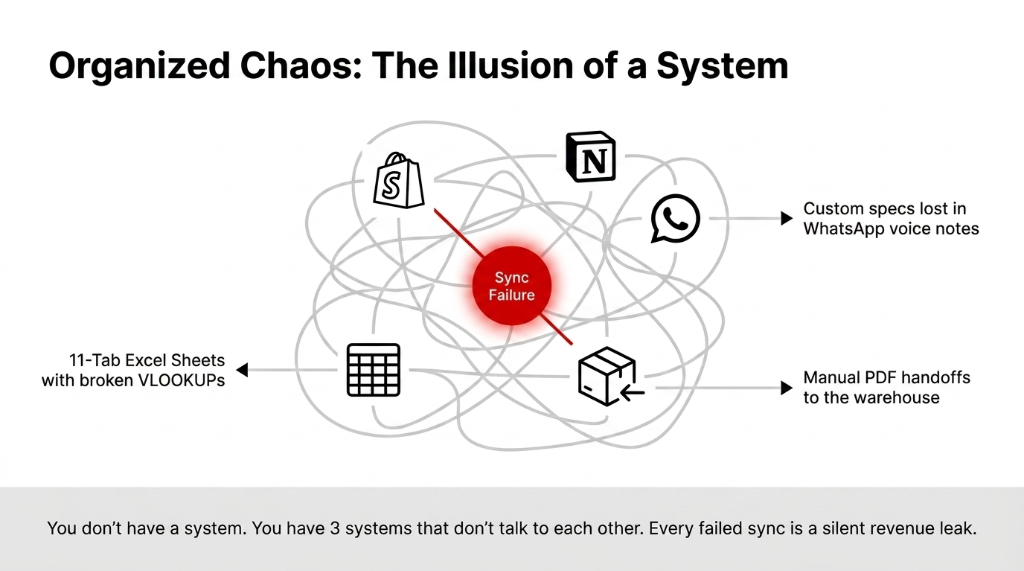
Why Your Current "System" Will Kill You at Scale
Frankly, the most dangerous thing is not chaos. It is organized chaos. Brands that have cobbled together Shopify + Shiprocket + a manual Excel inventory feel like they have a system. They do not. They have 3 systems that do not talk to each other, and every sync failure is a silent revenue leak.
Here is the ugly truth about home decor inventory specifically: your SKU count is deceptive. You might list 200 products on your Shopify store, but behind each one are 7 fabric options, 4 size variants, 3 finish choices — 5,600 effective SKUs your Excel sheet is pretending to track. When you run a Nykaa Fashion sale and 140 orders come in overnight, your warehouse team spends 37 hours the next week just reconciling what raw materials are actually left.
The Deceptive SKU Math That Breaks Every Spreadsheet
Visible SKUs
200 products listed on your Shopify store. Looks manageable.
Real SKU Load
5,600 effective SKUs — 7 fabrics x 4 sizes x 3 finishes per product.
Post-Sale Reconciliation
37 hours wasted after a single Nykaa Fashion sale reconciling raw materials.
The Diwali Disaster: $25,476 Lost in 11 Days
A Jaipur-based D2C furniture brand doing $14,286/month came to us after a Diwali sale catastrophe. They oversold 67 custom dining table orders because their Shopify inventory did not account for the shared raw material (teak wood logs) across 4 different product lines.
Refunds, courier reversals, and customer service hours cost them exactly $25,476 in 11 days.
The controversial opinion no one tells you: hiring a dedicated inventory manager to run your Excel system is not scaling — it is paying someone $4,762/year to maintain a broken machine.
What ERP for Home Decor D2C Actually Does Operationally
We are not selling you a dashboard. We are fixing the exact things that are bleeding you dry. Let us get specific.
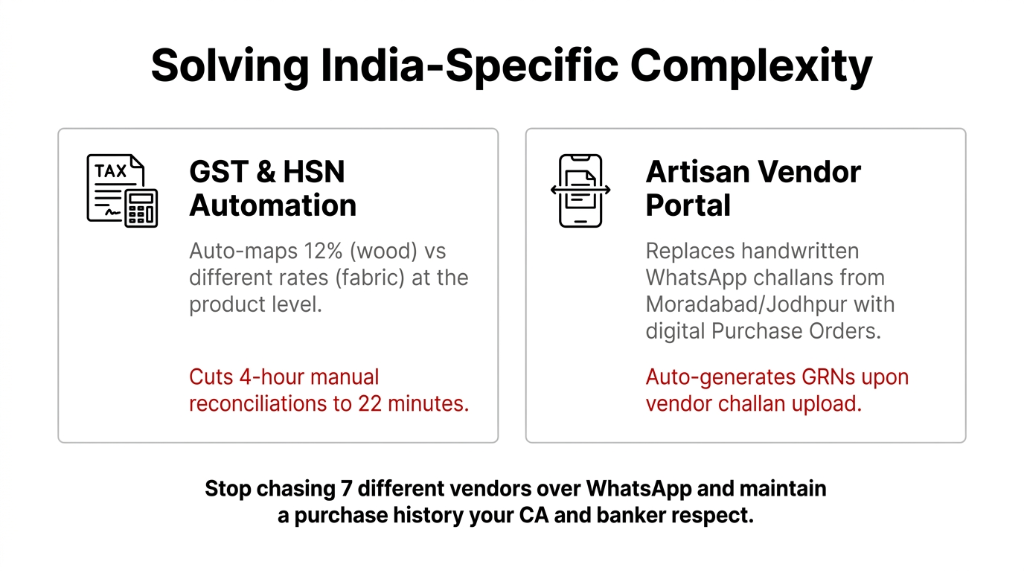
Custom Order Management — Configurable BOMs
Odoo's manufacturing module lets you build a configurable Bill of Materials. When a customer orders a "teak coffee table, 4x2 ft, matte black finish, hairpin legs," the ERP automatically pulls the correct quantities: 1.8 sq ft teak slab, 380ml matte paint, 4 hairpin leg units. The production order generates in under 60 seconds. Your procurement team sees raw material availability in real time — not 2 days later when someone physically counts the warehouse shelf.
Time Recovered: 13.5 Hours Every Month
Custom order processing drops from 18 minutes per order to under 3 minutes. At 90 custom orders a month, that is 13.5 hours your team gets back — every single month.
Multi-Warehouse + Raw Material Inventory
Home decor brands in India often run 2–3 inventory locations: a production workshop, a finished goods godown, and a vendor-managed raw material store. Odoo tracks all three under one roof, with real-time stock movement triggered by manufacturing orders, not manual entry.
When your fabric vendor in Surat ships 200 metres of linen, it lands in the "incoming" layer in Odoo. When your production team cuts 3.5 metres for a custom cushion cover, it is deducted automatically from the BOM. You stop paying for 200 metres of fabric and only finding 140 when it is time to fulfil. (Yes, this is more common than you think — we have seen shrinkage losses of 8–12% in manual setups.)
Shopify–Odoo Integration — No API Lag on Sale Days
The Braincuber Shopify–Odoo connector syncs orders every 90 seconds — not every 24 hours like standard plugins. When a customer places an order on your Shopify store, it appears in Odoo as a confirmed sales order with all custom attributes mapped. Your warehouse team never opens Shopify's backend.
And here is the insider detail most agencies will not tell you: Shopify's standard inventory API has a webhook delay of up to 4 minutes during traffic spikes. During a flash sale or a festive drop, that 4-minute window can mean 30–50 oversold orders. The Braincuber connector uses a push-pull hybrid sync that bypasses this limitation using Odoo's queue worker — keeping your live inventory accurate to within 1 order at all times.
The India-Specific Operational Complexity ERP Fixes
Running a home decor D2C brand in India is not the same as running one in the US or UK. Your GST compliance alone is a beast. Home decor products attract GST rates ranging from 5% to 28% depending on material classification. A wooden frame is 12% GST. Add a fabric panel and it might classify under a different HSN code. Get it wrong and your CAs spend 6 hours a month reconciling misclassified invoices — time they bill you $1,012 for.
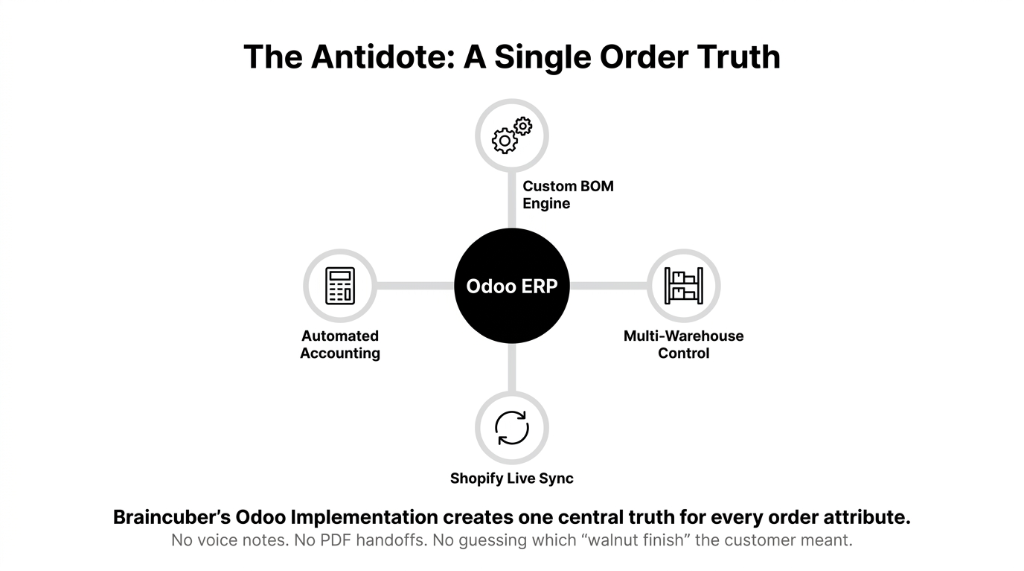
Odoo's Indian localization module handles HSN code mapping at the product level. Every invoice auto-populates the correct GST rate based on product category. Your GSTR-1 and GSTR-3B reconciliation drops from a 4-hour monthly exercise to a 22-minute review.
Vendor Management for Artisan Suppliers
Most Indian home decor D2C brands source from artisan clusters — Moradabad for brassware, Jodhpur for wood, Panipat for textiles. These vendors do not send you EDI files. They send you WhatsApp photos of handwritten challans.
With Odoo's vendor portal, you can issue digital purchase orders that your Moradabad supplier opens on their phone, confirms digitally, and attaches a challan scan to. Your GRN (Goods Receipt Note) is auto-generated when the challan is uploaded. Stop chasing 7 different vendors over WhatsApp and maintain a clean purchase history that your CA and your banker both respect. Already managing multi-channel inventory? This vendor layer plugs directly into it.
What the First 90 Days Look Like
We implement Odoo for home decor D2C brands in India in a phased 11-week rollout. No shortcuts. No "go-live on Day 5" fantasies.
| Weeks | Phase | What Actually Happens |
|---|---|---|
| 1–3 | Catalogue + BOM + Shopify | Product catalogue migration, Bill of Materials setup, and Shopify connector activation. Your team can take live orders by Day 21. |
| 4–6 | Warehouse Operations | Incoming stock, outgoing shipments, and raw material deductions move from Excel to Odoo. (Cleaning your 11-tab Excel file will take longer than you think.) |
| 7–9 | Accounting + GST | QuickBooks or Tally data migrated. GSTR-1 runs in Odoo for the first time. Your CA stops billing you $1,012/month for manual reconciliation. |
| 10–11 | Vendor Portal Live | Purchase orders, GRNs, and payment terms managed end-to-end. Your Moradabad supplier confirms orders from his phone. |
By Day 90, Our Clients Typically See
Post-Implementation Results (Real Clients)
Order Processing Time
Down from 18 min to under 3 min per custom order
Inventory Accuracy
Up from ~73% (manual average) to 97.4%
Overselling Incidents
Drop to zero for brands under $35,714/month GMV
GST Reconciliation
81% faster — from 4 hours to 22 minutes monthly
Real Recovery: $20,714 in 90 Days
One of our clients — a Mumbai-based D2C brand selling personalized gifting and home decor — recovered $20,714 in 90 days purely from plugging raw material shrinkage and mis-shipment losses they did not know existed.
The Cost of Waiting One More Festive Season
Diwali 2026 is approximately 6 months away. If you are planning a sale that does $35,714–$59,524 in 10 days on a broken operations setup, you are planning a refund disaster, not a revenue event.
At Braincuber, we have implemented ERP for home decor D2C brands in India, UAE, and the UK. We know exactly which 3 operational failures will hit you first — and in a 15-minute call, we can tell you which one is already costing you money this month.
Do not let another festive season run on WhatsApp threads and VLOOKUPs.
Frequently Asked Questions
How long does Odoo ERP implementation take for a home decor D2C brand?
For a home decor D2C brand with Shopify integration, custom order management, and Indian GST compliance, Braincuber's standard rollout is 11 weeks. Live order processing starts in Week 3. Full accounting and vendor portal activation completes by Week 11. Timelines shift by 5–7 days if your product catalogue has more than 800 SKUs.
Will Odoo handle made-to-order and configurable products like custom furniture?
Yes. Odoo's manufacturing module supports configurable Bills of Materials that auto-generate production orders and raw material deductions when a custom order is placed. Every custom attribute — size, material, finish, engraving — maps directly to the correct BOM without any manual intervention from your production team.
What happens to our existing Shopify store during migration?
Your Shopify store stays live throughout the entire implementation. Braincuber migrates your product catalogue, order history, and customer data into Odoo in parallel. The Shopify–Odoo connector activates after data validation. Zero downtime on your storefront, zero customer-facing disruption during the switchover.
How does Odoo ERP help with GST compliance for home decor products?
Odoo's Indian localization maps every product to the correct HSN code and GST rate at the product level. Invoices auto-populate with correct tax treatment. GSTR-1 and GSTR-3B reports generate directly from Odoo, cutting monthly GST reconciliation time by up to 81% — from roughly 4 hours to under 25 minutes per month.
What does ERP for home decor D2C cost, and when does it pay for itself?
Odoo implementation for a home decor D2C brand via Braincuber typically ranges from $2,976 to $7,143 depending on customisation depth. Most clients recover the full implementation cost within 4–5 months through inventory shrinkage recovery, reduced manual processing hours, and elimination of overselling losses. A brand doing $11,905/month GMV typically breaks even by Month 5.
Do Not Let Bad Operations Kill a Great Product
Check your returns folder right now. If it is full of oversold orders, wrong-finish complaints, and refund requests from your last sale — you already know the answer. Book our free 15-Minute Operations Audit. We will find your single biggest ops leak on the first call. No slides. No sales pitch. Just answers.
Diwali 2026 is 6 months away. Fix the backend now — or plan another refund disaster.