
What This Post Covers
▸ The $22,024/month subscription leak hiding in your Google Sheets
▸ Why FSSAI inspections are now unannounced — and your tools were never built for it
▸ Subscription churn dropped from 31% to 17% in 90 days with one ERP fix
▸ The 11–16 week implementation timeline — with 40 hours of data cleaning you must budget for
▸ Why NetSuite at $53,571 makes zero sense for brands under $2.38M ARR
The $22,024 Monthly Leak Nobody Talks About
Picture this: A protein supplement brand doing $261,905/month in D2C revenue. They sell on Shopify, Amazon, and their own app. They have subscription plans — 3-month, 6-month, and annual boxes. On paper, everything looks fine.
Backstage? A nightmare.
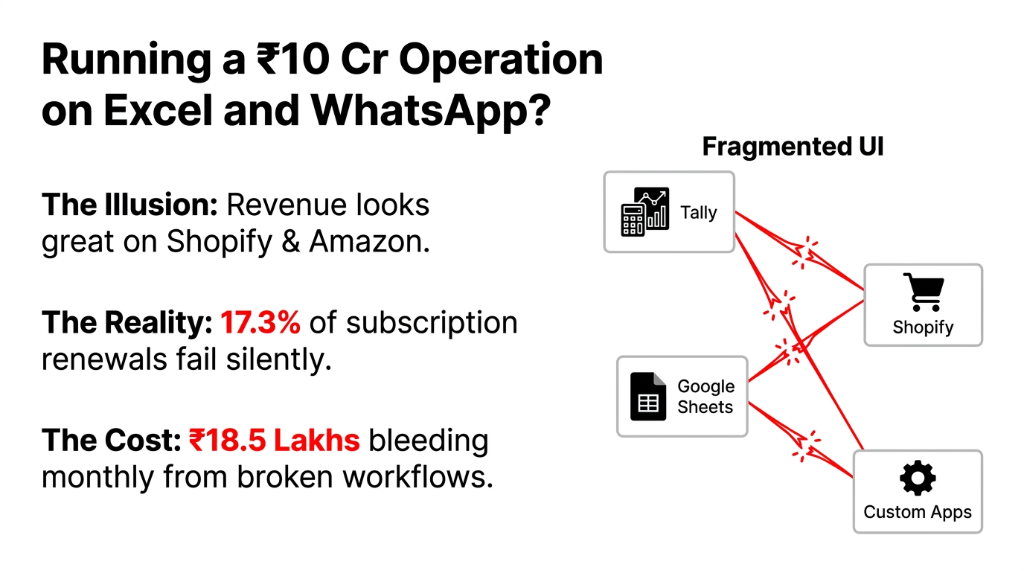
Their subscription renewals are tracked in a Google Sheet. When a customer's 3-month pack auto-renews, someone manually checks the sheet, creates an invoice in Tally, updates the stock count in a separate Excel file, and messages the warehouse guy on WhatsApp. (Of course it sounds familiar. We have seen this exact setup 23 times in the last 14 months.)
The Real Numbers
17.3% of subscription renewals were failing silently — expired payment methods, out-of-stock SKUs not flagged, invoices generated for wrong variants
Monthly bleed: $22,024 walking out through a hole nobody was watching
Why Your Current Setup Will Fail the Next FSSAI Audit
The FSSAI Health Supplements and Nutraceuticals Regulations 2016 are not suggestions. Under these rules, every Food Business Operator must maintain complete batch traceability — from raw material sourcing to finished product dispatch. Every label must carry compliant nutritional declarations. Every ingredient must be on the FSSAI-approved schedule list.
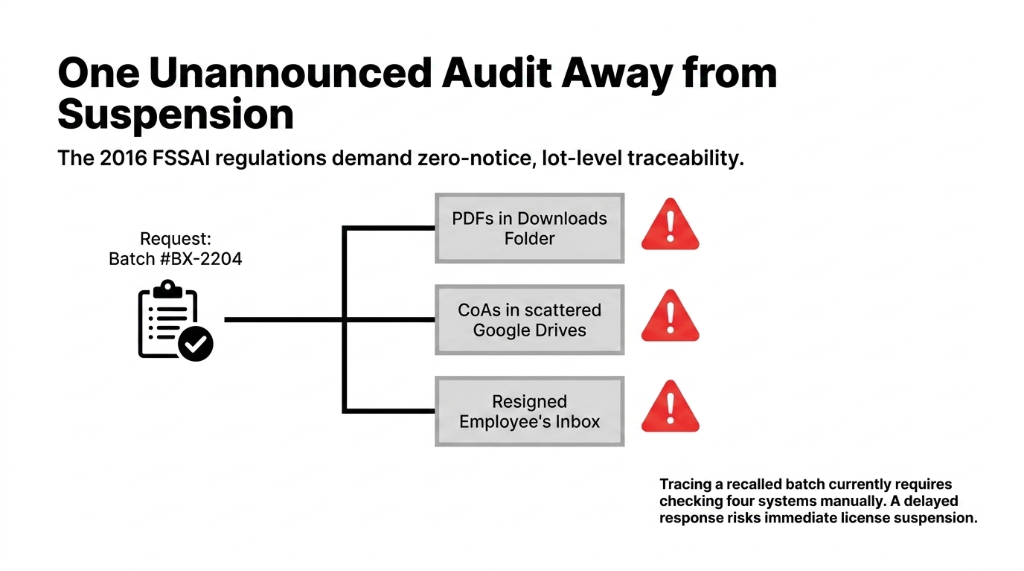
Here is what we see brands using to manage all of this: a mix of Tally for accounts, ShipStation for dispatch, a custom-built subscription app that breaks every 3rd month, and Excel for batch records.
That is four disconnected systems. When the FSSAI inspector asks you to trace Batch #BX-2204 — the lot with the whey protein that a customer complained about — you are opening four different tabs, calling two people, and praying someone saved the right file.
The Tools Were Never Built for Regulated Products
QuickBooks does not know what a CoA is. Shopify's inventory module has never heard of a Good Manufacturing Practice (GMP) log. And here is the insider detail most consultants will not tell you:
FSSAI inspections are increasingly unannounced since 2023. You do not get 30 days to "prepare documentation." You need it ready at zero notice.
The Subscription Time Bomb in the Supplement Industry
Subscription is the holy grail for supplement brands. Monthly recurring revenue, predictable cash flow, higher lifetime value. Every investor loves it. Every founder wants it.
But subscription for physical products — especially regulated consumables like protein powders, omega-3 capsules, and probiotic sachets — is operationally 4x harder than for SaaS. Here is why:
Expiry Dates Are a Hard Constraint
A customer's 6-month subscription must dispatch products that will not expire before they finish the last serving. Your system needs to auto-calculate shelf life at dispatch. Not rely on a warehouse guy eyeballing dates.
Batch Variation Must Match Subscription History
If a customer reports a reaction, you need to know exactly which batch they received in month 2 of their subscription — not "somewhere from Q3."
Churn Kills at 28–32% Annually
Subscription churn in supplements averages 28–32% annually when fulfillment quality dips. Miss one delivery, send the wrong flavour variant, or dispatch an item 4 days late — and that customer does not just cancel.
They leave a review that costs you $71 in ad spend to neutralize.
Payment Gateway Failures Run at 9–14% Monthly
Due to RBI tokenization norms and auto-debit restrictions, without automated retry logic connected directly to your inventory and dispatch workflow, those failed payments become lost orders — not recovered revenue.
We worked with a nutraceutical brand — $101,190/month GMV — that was manually managing 1,400 active subscriptions in Razorpay's dashboard combined with a custom Shopify plugin. When Shopify pushed an update in Q2 2024, the plugin broke. They lost 11 days of subscription renewal data. That is a $36,905 gap in reconciliation.
What ERP for Health Supplement Brands Must Actually Do
Generic ERP advice says "automate your processes." That is useless. Here is exactly what an ERP implementation for a health supplement brand must handle, non-negotiably:
Non-Negotiable ERP Requirements
Compliance
Auto-generate CoAs from batch records. GMP checklists in production workflow. Expiry management at SKU-batch-subscription level. FSSAI label compliance checks. Audit-ready electronic batch records in under 3 minutes.
Subscription
Renewal logic checks real-time inventory + batch expiry before confirming. Automated payment retry on 3rd, 7th, 14th day. Flavour swaps and pause requests without orphaned orders. Revenue recognition separating billed vs. fulfilled.
Operations
Shopify-ERP sync pushing subscription orders to warehouse in under 90 seconds. Multi-channel inventory with hard reservations for active subscriptions. No more overselling committed stock.
What Odoo Does Here That NetSuite Cannot Justify
If you are a $5.95M supplement brand, maybe NetSuite makes sense. But for the $238,095–$2.38M D2C supplement brand — which is 83% of the market — NetSuite is a $53,571 implementation that takes 14 months and requires a dedicated in-house ERP admin. That is money your brand does not have and time your market will not give you.
Odoo's health supplement module — when implemented correctly — handles the full compliance + subscription workflow on a single platform, with a deployment timeline of 11–16 weeks for a mid-sized brand. We configure it with a custom batch traceability module mapped to FSSAI's lot-level requirements, subscription billing connected directly to the inventory reservation engine, automated CoA generation from quality control entries, and Shopify integration that syncs subscription orders bidirectionally.
Real Client Result
Client: Mumbai-based collagen and beauty supplement brand, $166,667/month
Before: 23 manual steps per subscription renewal. Churn at 31%.
After: 4 automated steps. Subscription churn dropped from 31% to 17% in 90 days. Not because the product changed. Because customers stopped receiving wrong variants and late dispatches.
The Implementation Reality (No Sales Fluff)
| Weeks | Phase | What Actually Happens |
|---|---|---|
| 1–3 | Data Migration | Migration from Tally, existing Shopify subscription data, and batch/lot history. 70% of implementations hit delays here. Budget 40 hours of data cleaning. Seriously. |
| 4–8 | Core ERP Config | Inventory, procurement, batch tracking, quality control, FSSAI compliance workflow. Parallel run with existing systems. You do not go live blind. |
| 9–12 | Subscription Module | Subscription billing, payment gateway integration (Razorpay/PayU/Stripe), Shopify sync, automated retry logic. UAT with your ops team — not just IT. |
| 13–16 | Go-Live + Support | First 30 days post-go-live are monitored. Every failed transaction gets a root-cause ticket. |
Expected ROI in the First 6 Months
Churn Reduction
11–14 percentage point drop in subscription churn within 90 days of go-live
Payment Recovery
60–70% of previously lost renewals recovered through automated retry logic
Compliance Speed
Documentation time from 6 hours per audit to under 45 minutes. For a $238,095/month brand: $16,667–$26,190 recovered annually from subscription alone.
Already running Odoo for other operations? Adding the supplement compliance and subscription module takes 4–6 weeks on an existing instance.
Frequently Asked Questions
How long does Odoo ERP implementation take for a health supplement brand?
For a D2C supplement brand doing $11,905–$238,095/month, a full implementation — including FSSAI batch compliance, subscription billing, and Shopify integration — takes 11 to 16 weeks. Timelines stretch when source data is messy. Budget 3 weeks for data cleaning before kickoff.
Can Odoo handle FSSAI batch traceability requirements?
Not entirely out of the box — but with the right configuration partner, yes. FSSAI's lot-level traceability, CoA generation, and GMP logging need to be mapped to Odoo's quality and manufacturing modules. We configure this specifically for supplement regulations, not generic food industry templates.
How does ERP fix subscription churn for supplement brands?
ERP connects inventory availability, batch expiry, and payment retry logic into one workflow. This prevents the three biggest churn triggers: wrong variants shipped, late dispatch due to untracked stock, and failed renewals not retried. Brands typically see churn drop 11–14 percentage points within 90 days.
Is Odoo cost-effective for a supplement brand doing $238,095/month?
Yes. NetSuite and SAP implementations start at $47,619–$71,429 for mid-market brands. Odoo implementations for supplement brands in this revenue range typically run $9,524–$21,429 total, with monthly licensing under $179. ROI turns positive within 4–6 months.
What happens to existing Shopify and Tally data during migration?
All historical order data, customer subscription records, inventory transactions, and financial entries are migrated before go-live. We run a parallel operation period — typically 3–4 weeks — where both systems run simultaneously. Nothing goes dark. No customer sees a disruption. See how multi-channel sync works.
Stop Letting Subscription Chaos Eat Your Margins
Book our free 15-Minute Operations Audit. We will find your biggest compliance or subscription leak in the first call. If your subscription failure rate is above 8%, we already know where the money is going.
Pull up your subscription renewal report right now. If more than 10% are failing silently, you already know you need this call.