
What This Post Covers
▸ Why your Shopify + Tally + Excel stack guarantees compliance failures for food D2C
▸ The exact FSSAI e-commerce directive that makes manual expiry tracking illegal
▸ How FEFO enforcement in Odoo cut expiry write-offs by 31% in 6 months
▸ Cold chain IoT integration that dropped spoilage from 4.7% to 1.1% of revenue
▸ The 90-day implementation timeline — no fairy tales, actual week-by-week reality
The Food Safety Trap Nobody Warns You About
Here is what the compliance consultants conveniently leave out of their decks: the FSSAI e-commerce directive (November 2024) now mandates that every online food business operator must ensure a minimum shelf life of 30% or 45 days remaining at the time of delivery to the consumer.
Read that again. Not 30% from manufacture. 30% at the point of customer delivery.
That means if your protein bar has a 12-month shelf life and it has been sitting in your 3PL warehouse for 9 months already, you cannot legally ship it. You have to write it off. And if you do ship it — which happens every day when you are running dispatch on manual Excel checks — you are in direct violation.
Penalty Structure (Real Numbers)
Selling expired food: $2,381 per incident, plus up to 1 year imprisonment
Failing to maintain records: $595 to $1,190, plus license suspension
Operating on expired license: Up to $11,905 fine
This is not a compliance problem. It is an operations problem. And no compliance consultant can fix it — only your ERP can.
Why Your Current Stack Is Failing You
We constantly see the same broken architecture: Shopify for orders, Tally for accounting, a WhatsApp group for warehouse updates, and a shared Excel file titled "EXPIRY_TRACKER_FINAL_v3_USE_THIS.xlsx" that three people have edit access to.
That is not operations. That is a liability.
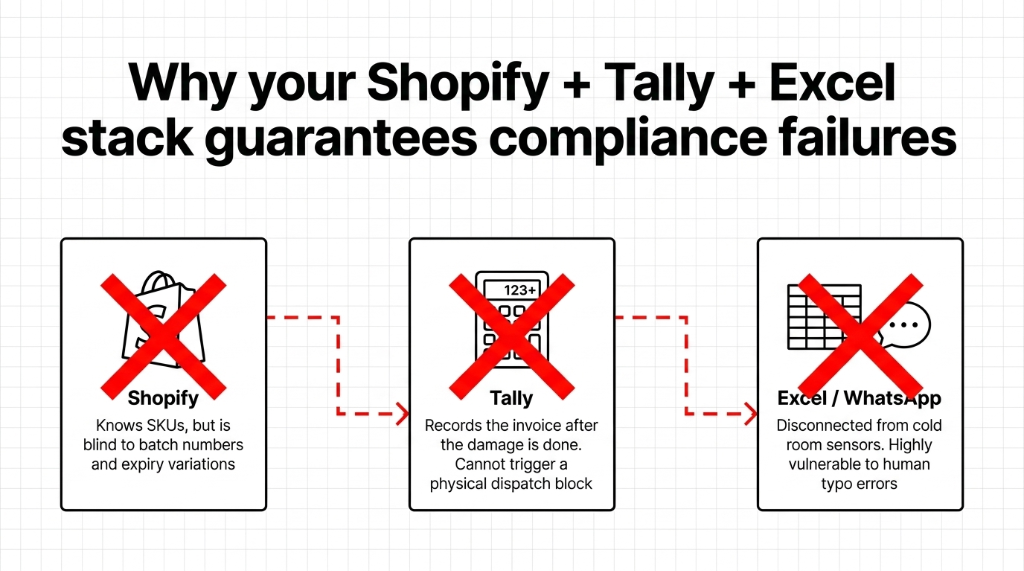
Shopify Does Not Know Your Batch Numbers
It knows SKUs. It does not know that the same SKU "WHEY-CHOC-1KG" has three separate batches in your cold store, with expiry dates in October 2025, March 2026, and August 2026.
Hidden cost: $1,190–$5,950/year in mis-shipped near-expiry product
Tally Cannot Trigger a Dispatch Block
When a batch breaches the 45-day rule, Tally will not stop your warehouse from shipping it. It will just record the invoice after the damage is done.
Hidden cost: One regulatory penalty wipes out a quarter's margin
Excel Cannot Talk to Your Cold Room Sensors
When your cold store temperature drifted from 4°C to 11°C at 2 AM on a Sunday, nobody found out until Monday morning — 7 hours after the dairy products crossed the spoilage threshold.
Hidden cost: 2.8% of monthly GMV in invisible spoilage
NetSuite will tell you they can solve this. They can — if you have $53,571 for implementation and another $14,286 a year in license fees. For a food D2C brand doing $595,000–$2.38M ARR, that is a cash flow killer, not a solution.
What ERP Actually Does for Food D2C Compliance
A properly configured Odoo ERP — built specifically for food D2C operations — solves the three core failure modes simultaneously. Not with a brochure. With hard-coded logic that your warehouse team cannot bypass.
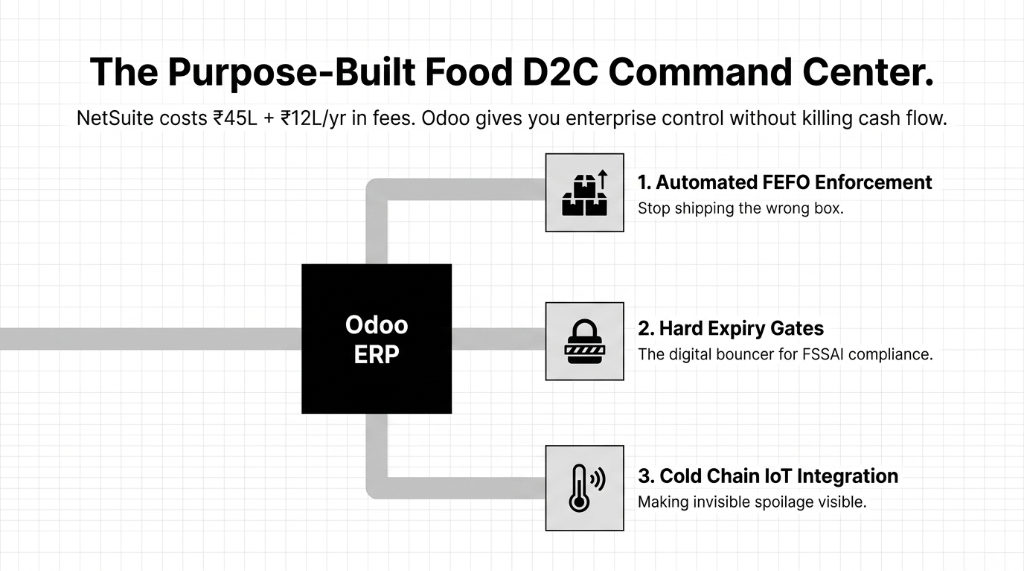
1. Batch and Lot Traceability with FEFO Enforcement
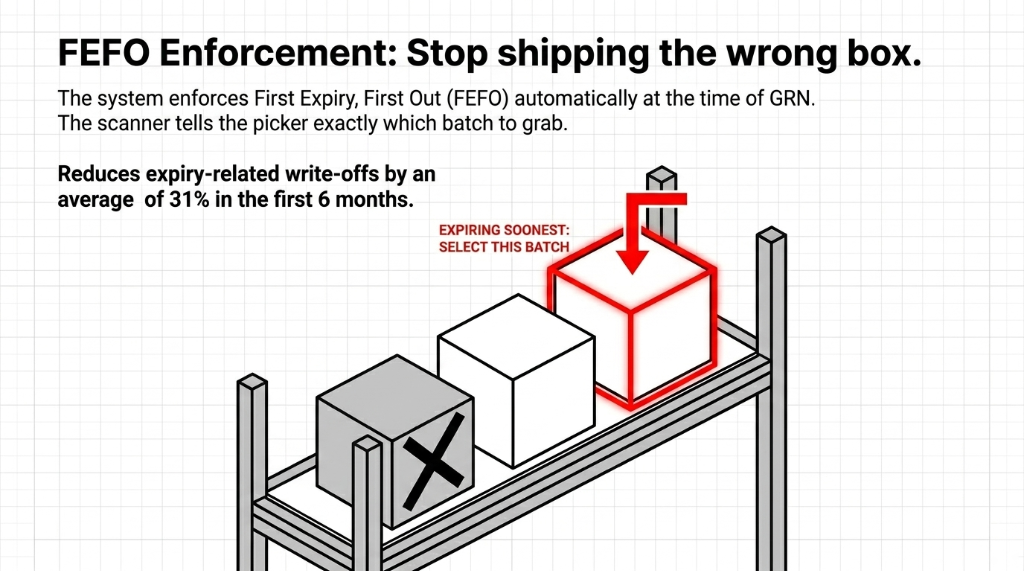
Every inbound shipment from your manufacturer gets a batch number, a manufacturing date, and an expiry date logged at the time of GRN (Goods Receipt Note). The system enforces FEFO (First Expiry, First Out) automatically — so when a dispatch order is generated, Odoo picks from the batch that expires soonest, not the one sitting closest to the packing table.
Result From Our Implementations
Across food brands scaling from $238,095 to $1.78M ARR, FEFO enforcement alone reduced expiry-related write-offs by an average of 31% within the first 6 months.
2. Automated Expiry Gate
We configure a hard dispatch block in Odoo: if the batch being shipped has less than 30% shelf life remaining (calculated dynamically against the system date and delivery lead time), the system refuses to generate a delivery order.
The warehouse cannot override it without a manager-level approval that creates a timestamped audit trail. This is exactly the kind of digital audit trail food safety inspectors look for during e-commerce FBO audits.
Audit Trail Generation Speed
Without ERP
3–4 hours of backward reconciliation across Shopify, Tally, and Excel. Hope you did not delete that WhatsApp message.
With Odoo ERP
Complete batch-level report — what shipped, when, to which customer, with what remaining shelf life — in under 4 minutes.
3. Cold Chain IoT Integration
Here is something your ERP vendor's brochure probably does not explain clearly: Odoo does not natively monitor cold room temperatures. But with an IoT bridge layer connecting to your cold storage sensors, temperature deviations above threshold (say, above 6°C for dairy, above -15°C for frozen) trigger automatic alerts and flag all affected batches in Odoo for quality review before they are dispatched.
Real Client Numbers
Client: D2C dairy brand, $214,286 monthly revenue
Before: Cold chain spoilage at 4.7% of revenue
After: Spoilage dropped to 1.1% within the first quarter
Annual savings: $9,881
The Compliance Reporting Nobody Talks About
Beyond expiry and cold chain, food safety regulations mandate that e-commerce food business operators maintain and produce records of food ingredients, safety checks, and operational documents on demand.
In Odoo, every purchase order, GRN, quality check, batch release, and dispatch note is a document that is linked, timestamped, and retrievable. When an inspector walks in — and in 2025-26, they are walking in more frequently, especially for fast-growing D2C brands — you can generate a complete traceability report in minutes, not days.
We also configure automated license renewal alerts inside Odoo. Because operating on an expired food safety license now attracts a penalty of up to $11,905, and we have seen brands miss renewal simply because the reminder was buried in someone's Gmail. (Yes, really.)
What the First 90 Days Actually Look Like
We are not going to promise that you flip a switch and compliance solves itself. Here is the actual implementation reality:
| Week | Phase | What Actually Happens |
|---|---|---|
| 1–3 | Data Migration | Every SKU gets mapped to its correct shelf life parameters, temperature storage requirements, and product category. |
| 4–6 | Warehouse Onboarding | Your team learns GRN with batch entry, FEFO pick-and-pack workflows, and expiry dashboard. Takes 18–22 hours of training — not the "2-day workshop" most vendors quote. |
| 7–10 | Cold Chain IoT | Sensor data starts flowing into Odoo. Alert thresholds are calibrated. Two weeks of parallel monitoring before going live. |
| 11–12 | Audit Trail Test | We simulate an inspection scenario and walk you through the report generation process. Under 4 minutes or we re-configure. |
By the end of 90 days, your dispatch team goes from spending 45 minutes per shift manually cross-checking expiry dates to spending zero minutes — because the system blocks bad batches automatically.
The One Metric That Pays for Everything
The ROI conversation for food D2C ERP is simpler than people think.
Take your average monthly GMV. Apply an honest 2.8% spoilage and write-off rate (that is the industry average for food D2C brands operating on manual systems, per our internal data across 23 implementations). That number — 2.8% of monthly GMV — is what you are losing every single month in expired stock, cold chain failures, and mis-picked batches.
The Math That Kills the "ERP Is Expensive" Argument
Monthly Bleed
$59,524/mo GMV x 2.8% = $1,667/month in recoverable losses
Annual Drain
That is $20,000/year walking out the door in expired stock and spoilage
Odoo Implementation
Full food D2C setup costs $4,167–$7,143. Payback period: under 5 months.
Stop letting the ERP implementation cost scare you. The cost of not implementing is $20,000 a year, a potential $11,905 regulatory fine, and the reputational damage of a consumer complaint to food safety authorities.
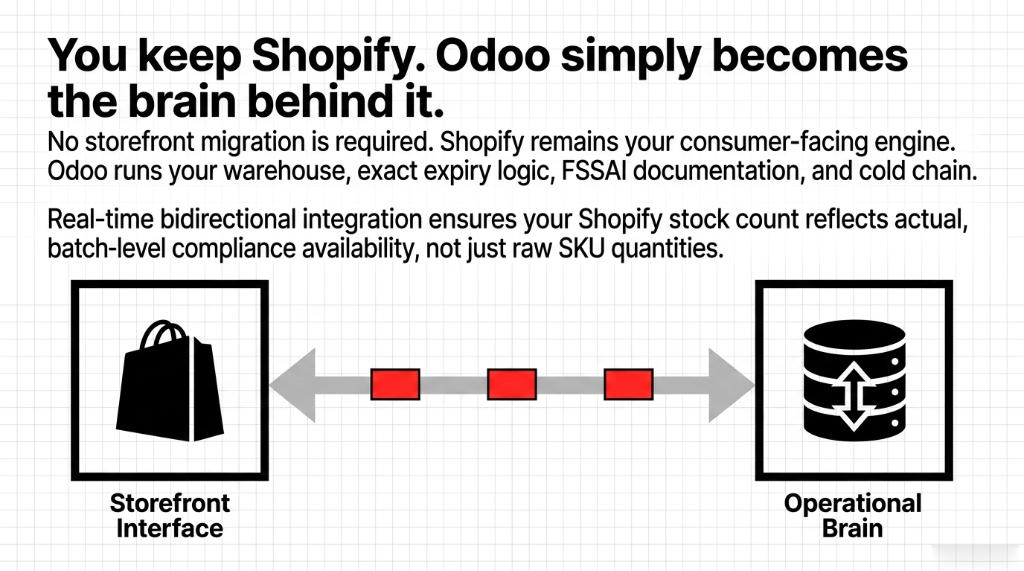
Your Shopify Store Stays. Odoo Becomes the Brain.
No storefront migration required. Shopify remains your consumer-facing engine. Odoo runs your warehouse, exact expiry logic, food safety documentation, and cold chain monitoring behind it.
Real-time bidirectional integration ensures your Shopify stock count reflects actual, batch-level compliance availability — not just raw SKU quantities. When a batch crosses the expiry threshold, it disappears from your Shopify available stock automatically. No WhatsApp message needed.
We have built this exact setup for 23 food D2C brands. The integration takes 2–3 weeks to configure and test. Your Shopify store stays live the entire time. Zero downtime. See how our Odoo ERP integration works.
Frequently Asked Questions
Does Odoo ERP natively support batch tracking for food D2C?
Yes — Odoo's inventory module supports lot and serial number tracking with custom expiry date fields. We extend this with food-specific configurations: 30% minimum shelf life gates, FEFO enforcement, and auto-blocked dispatches for near-expiry batches. Setup takes 3–4 weeks for a standard food D2C warehouse.
Can ERP integrate with cold storage temperature sensors?
Yes, but not out of the box. Odoo requires an IoT bridge layer to pull data from cold room sensors or data loggers. We configure this integration so temperature breaches automatically flag affected batches in Odoo for quality hold — stopping compromised product from being dispatched before anyone physically checks the warehouse.
What is the minimum business size where ERP makes sense for food D2C?
If you are shipping more than 200 orders per day or managing more than 3 active SKU batches simultaneously, manual expiry tracking is already costing you more than ERP would. Food D2C brands above $35,714 per month GMV recover the full ERP investment within 4–6 months through reduced spoilage alone.
How does ERP help during a food safety inspection?
Odoo generates a complete traceability report — batch origin, GRN date, quality check log, storage temperature history, and dispatch details — in under 4 minutes. That is what inspectors want: a documented, timestamped audit trail from raw material receipt to consumer delivery. Manual systems cannot produce this on demand.
Do we have to migrate off Shopify?
No migration needed. Our Shopify-Odoo integration syncs orders, inventory, and batch data bidirectionally. Shopify stays as your storefront; Odoo runs your warehouse, expiry logic, food safety documentation, and cold chain monitoring behind it.
Already running multi-channel? See how our Odoo implementation services handle food D2C complexity from day one.
Stop Bleeding Cash and Risking Your License
Book our free 15-Minute Operations Audit. We will pinpoint your exact expiry and cold chain leak in the first call. If we cannot find at least $1,190/month in recoverable losses, we will say so.
Check your returns folder right now. If there is a single expired-product complaint in the last 90 days, you already know you need this call.