
What This Post Covers
▸ Why 200 products become 1,600 active SKUs — and why Excel cannot track them
▸ The $11,000–$19,000/month you are losing to preventable operational failures
▸ How Shopify's API throttle at 2 calls/second caused a $23,400 Black Friday disaster
▸ Bundle BOMs, serial tracking, and demand forecasting that actually work at scale
▸ Why NetSuite at $80,000–$150,000 will kill your margins before it fixes your ops
The $196 Billion Market Running on Spreadsheets
The electronics accessories segment — phone cases, charging cables, TWS earbuds, laptop stands, screen protectors, gaming peripherals — is one of the highest-SKU, highest-return-rate verticals in D2C. The market is worth $196.98 billion globally and growing at 6.3% annually. Mobile accessories alone hold over 32% of the total market share.
Here is the problem that category creates operationally: you are not selling five products. You are selling 500 variants. A single charging cable SKU can have 8 variants (colour x connector type x cable length). Multiply that across a 200-product catalog and you have 1,600 active SKUs to track, replenish, and fulfill daily. Try doing that in Excel.
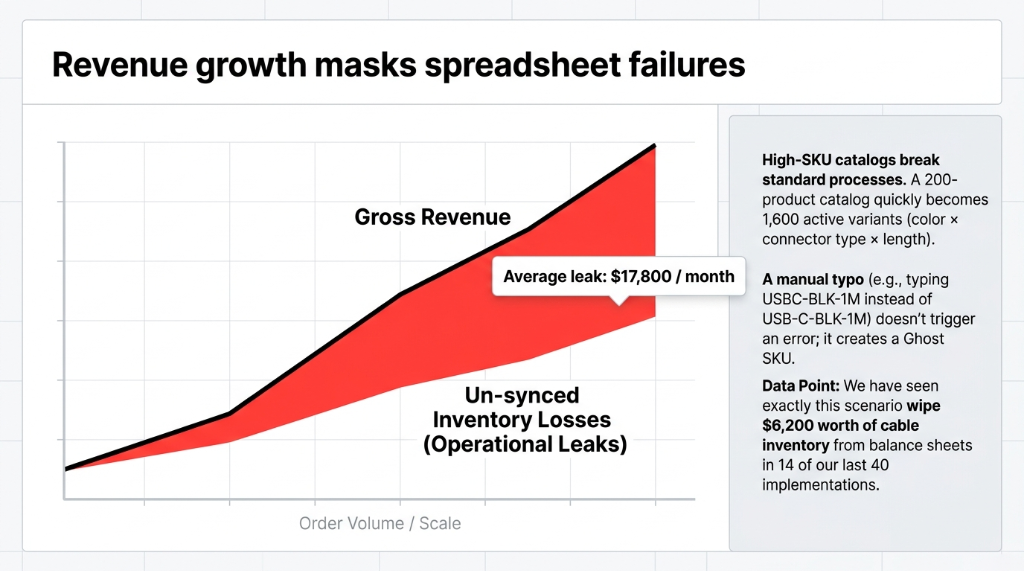
We have seen the ghost SKU scenario in 14 of our last 40 implementations for electronics D2C brands across the US, UK, and UAE. A manual typo does not trigger an error — it just creates a phantom record. And suddenly, $6,200 worth of cable inventory disappears from your balance sheet.
Why Your "Multi-Tool Stack" Is Actually Your Biggest Problem
Everyone tells electronics accessories founders to just "integrate their tools." Connect Shopify to ShipStation. Connect ShipStation to QuickBooks via Zapier. Add a Klaviyo webhook for post-purchase flows. Done, right? Wrong.
Shopify's inventory API has a documented rate limit of 2 calls per second. During a flash sale or a product launch spike — exactly when your inventory data needs to be most accurate — that API throttles. Orders flood in. 300 orders do not sync to your warehouse management system. Your warehouse ships the wrong variants. Returns start piling up within 48 hours.
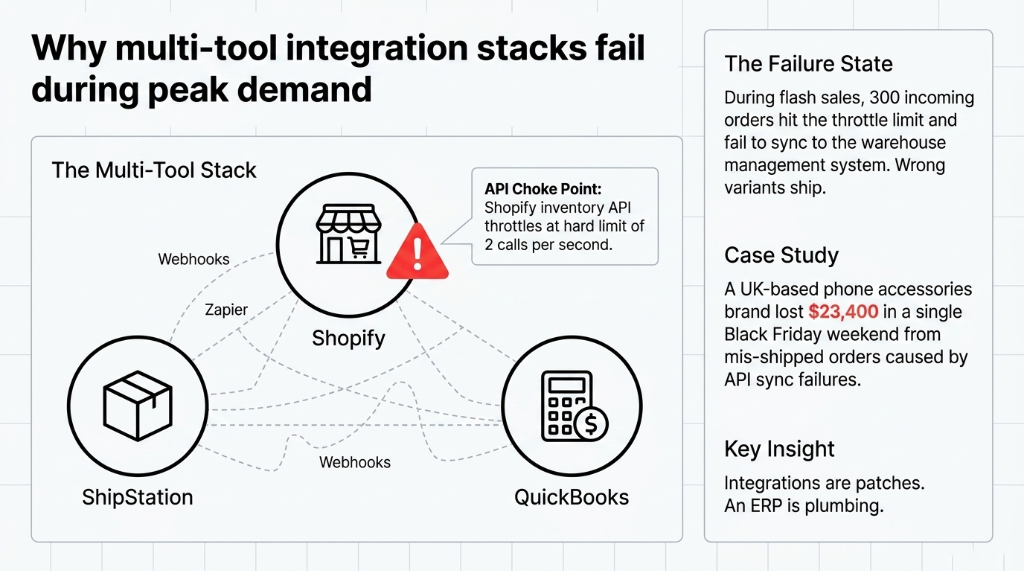
Black Friday Weekend: $23,400 Gone
A UK-based phone accessories brand lost $23,400 in one Black Friday weekend solely from mis-shipped orders due to API sync failures between Shopify and their legacy WMS. They had "integrations." They did not have an ERP.
Integrations are patches. An ERP is plumbing.
When you run Odoo ERP with Shopify connected natively, every order placed on your storefront updates the warehouse pick list, the purchase reorder trigger, the financial ledger, and the customer record — simultaneously. Not via a Zap. Not via a webhook that times out. Via a single unified database. That is not a feature. That is the architecture your business needs to exist at $5M ARR and above.
What ERP for Electronics Accessories D2C Actually Fixes
Let us be specific. Because "ERP handles everything" is the kind of vague answer that makes you close the browser tab. Here is what breaks at scale in this vertical — and what Odoo fixes:
Bundle and Kit Management
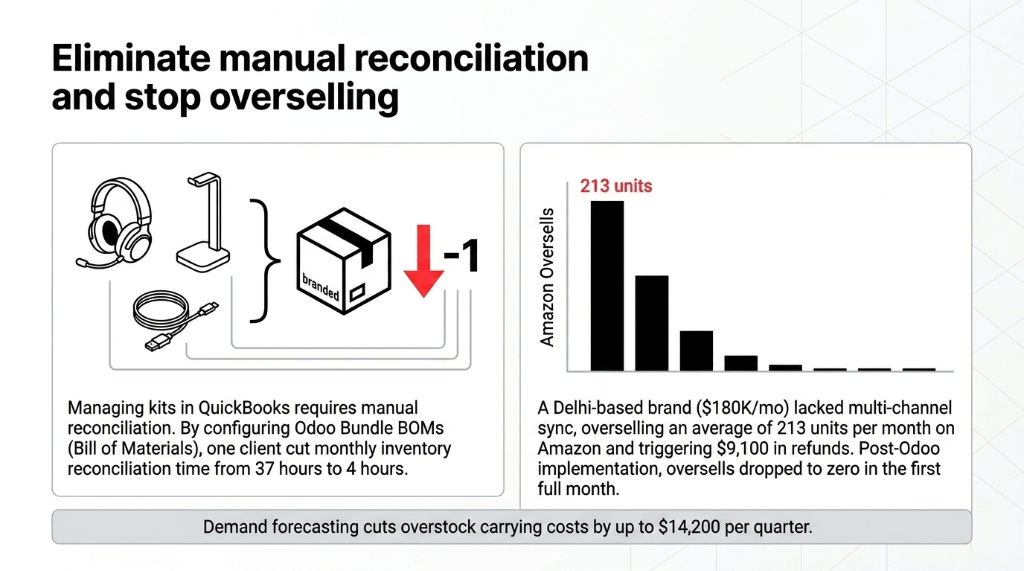
A gaming accessories brand does not just sell headsets. They sell bundles: headset + stand + cable. Every bundle sale needs to decrement three separate SKU counts simultaneously. In QuickBooks + Shopify alone, this requires manual reconciliation. In Odoo, bundle BOMs (Bill of Materials) handle this automatically, updating all component stock in real time.
Warranty and Serial Number Tracking
Electronics accessories brands with average order values above $45 face this constantly: a customer claims warranty on a product you have no record of selling to them. Without serial number tracking tied to order data, you either approve every warranty claim (and leak money) or reject them all (and destroy your NPS). Odoo's lot and serial tracking links every unit to the original order at the point of shipping — so your support team can pull up a product's full journey in 8 seconds, not 8 minutes.
Multi-Channel Inventory Sync
If you sell on your Shopify store, Amazon, Flipkart, and a B2B wholesale portal simultaneously, your inventory is being hit from four directions at once. Without a single source of truth, you will oversell. We worked with a Delhi-based accessories brand doing $180,000/month — they were overselling on Amazon an average of 213 units per month, triggering $9,100 in refunds and seller account warnings. Post-Odoo implementation, oversells dropped to zero in the first full month.
What Odoo Fixes — By the Numbers
Bundle Reconciliation
Monthly inventory reconciliation cut from 37 hours to 4 hours with a single BOM configuration
Overselling Eliminated
Delhi brand: 213 oversells/month dropped to zero in the first full month. $9,100/month in refunds recovered.
Overstock Carrying Costs
Demand forecasting cut overstock costs by $14,200/quarter for a Singapore client in six months
Returns Processing
18.5% return rate. 9 minutes per return down to 45 seconds. 200 returns/month = 30 hours saved.
Demand Forecasting for High-SKU Catalogs
Electronics accessories are season-sensitive (Diwali, Christmas, back-to-school) and trend-sensitive (every new iPhone release creates a 3-week cable/case demand spike). Odoo's forecasting engine uses 18 months of historical sales data to predict reorder points per SKU — so you are not hand-ordering cable stock in October and hoping for the best. One of our Singapore clients cut overstock carrying costs by $14,200/quarter in the first six months post-implementation.
Returns Processing at Scale
The average return rate in electronics accessories is 18.5% — higher than apparel. Processing each return manually across Shopify, your 3PL, and QuickBooks takes an average of 9 minutes per order. At 200 returns/month, that is 30 hours of pure admin work your ops team is eating. Odoo's returns workflow auto-triggers restocking, credit notes, and refund initiation in one click. Forty-five seconds per return. Done.
The Controversial Truth About NetSuite
Here is an opinion nobody in enterprise software will say out loud: NetSuite is not built for your business.
If you are a D2C electronics accessories brand doing under $20M ARR, NetSuite's implementation cost alone — typically $80,000–$150,000 for a mid-market rollout — will eat your gross margin for a full quarter. Add the $3,000–$8,000/month licensing fee and the 6–9 month go-live timeline, and you have spent your Series A budget before you have synced a single order.
We Have Rescued 3 Brands Post-Failed NetSuite Implementations
The common thread? The sales team convinced the founder it was "enterprise-grade." It is. It is also enterprise-priced, enterprise-complex, and built for companies with dedicated IT teams — not a 12-person D2C operation managing 800 SKUs from a Shopify store.
Odoo implementation for D2C electronics: $8,000–$22,000. Go-live in 8–12 weeks. (Yes, we know the NetSuite sales rep told you otherwise.)
What the First 90 Days Look Like With Odoo
We are not going to sell you magic. Here is the honest implementation timeline for a $3M–$10M electronics accessories D2C brand:
| Weeks | Phase | What Actually Happens |
|---|---|---|
| 1–3 | Data Migration | Every SKU, supplier, and open PO moves from QuickBooks/Excel/legacy WMS into Odoo. Expect 40–60 hours of your ops team's time. Plan for it. |
| 4–6 | Connectors + BOMs | Shopify + marketplace connector setup, warehouse routing rules, and bundle BOM configuration. Average bug-fix cycle in this phase: 6–8 working days. Not 2. |
| 7–9 | UAT + Warehouse | User Acceptance Testing with your ops and warehouse team. This is where you discover your team has been using unofficial workarounds for years. (Good. We need to know that.) |
| 10–12 | Go-Live + Cutover | Parallel run for 2 weeks, then full cutover. By day 85, inventory, order management, accounting, and returns run on one platform. Your Monday morning 90-minute reconciliation call disappears entirely. |
The Numbers That Should Make You Act Now
Global D2C revenue hit $583.48 billion in 2024 and is projected to reach $2.75 trillion by 2033 at 17.3% CAGR. The electronics accessories segment sits inside one of the fastest-growing pockets of that market.
73% of growing D2C companies cite poor inventory management as their single biggest operational challenge. Companies running integrated ERP systems reduce operational errors by 35% in the first year.
$132,000–$228,000 a Year. Preventable.
The average electronics accessories D2C brand at $3M ARR is leaking $11,000–$19,000 per month in refunds, overstock carrying costs, overtime hours, Amazon seller account health warnings, and customer churn from late shipments.
That is $132,000–$228,000 a year. Enough to hire three people, run three product launches, or fund an entire new category expansion.
Frequently Asked Questions
How long does Odoo ERP implementation take for an electronics accessories D2C brand?
For a brand managing 200–1,000 SKUs across Shopify and 1–2 marketplaces, implementation runs 8–12 weeks end-to-end. This includes data migration, Shopify integration, warehouse setup, and a 2-week parallel run before full cutover. Brands that dedicate an internal ops lead to the project consistently go live faster.
What does Odoo ERP cost for a D2C electronics brand?
A full Odoo implementation — covering inventory, order management, Shopify integration, accounting, and basic reporting — costs $8,000–$22,000 for a D2C brand at the $2M–$10M ARR range. Monthly licensing runs $300–$900 depending on user count and hosted vs. on-premise. This is 6–8x cheaper than a comparable NetSuite rollout.
Will Odoo sync in real time with Shopify during flash sales?
Yes — but only if implemented correctly. The native Odoo-Shopify connector syncs orders, inventory, and customer data every 5 minutes by default. For brands running flash sales or live commerce events, we configure webhook-based instant sync. This eliminates the API throttling problem that kills inventory accuracy during high-traffic windows.
Can Odoo handle returns and warranty claims for electronics accessories?
Odoo's returns module supports one-click return initiation, automatic credit note generation, and restocking workflows. When combined with lot/serial number tracking, every unit is linked to its original sale order — making warranty validation instant. Brands processing 150+ returns/month typically save 25–30 hours of admin work per month post-implementation.
What happens to our existing data in QuickBooks during migration?
Nothing gets deleted until you approve the migration. We run a full data audit first — mapping all SKUs, open POs, customer records, and financial history — then migrate in a staging environment. You review and sign off before anything goes live. Your QuickBooks data remains accessible in parallel for the first 30 days post-go-live as a safety net.
Stop Bleeding Cash. Start Building Infrastructure.
Every month you delay implementing a proper ERP, you are paying for it — in refunds, in overstock carrying costs, in overtime hours, in Amazon seller account health warnings, and in customer churn from late shipments. Book our free 15-Minute Operations Audit — we will identify your single biggest operational leak in the first call, at zero cost.
If you are at $2M ARR and your ops are still duct-taped together, you are not building a brand. You are building a liability.