
What This Post Covers
▸ The $1,357/month inventory leak hiding between your Shopify, Amazon FBA, and Google Sheet
▸ Why Shopify's inventory API lags 4–7 minutes during flash sales — costing you $2,226 in refunds
▸ How one brand recovered $2,738 in unaccounted COD remittances in the first reconciliation cycle
▸ Inventory accuracy from 67–74% to 98.3% in 60 days
▸ 8–10 week implementation timeline — no sugarcoating
The $1,357/Month Leak Nobody Talks About
Here is what actually happens when a baby D2C brand hits the $238,095–$476,190 ARR mark. You start selling on Shopify. Then Amazon and Meesho. You add a Myntra listing. Now you have four channels, and your "inventory system" is a guy who updates a shared Google Sheet every morning — if he remembers.
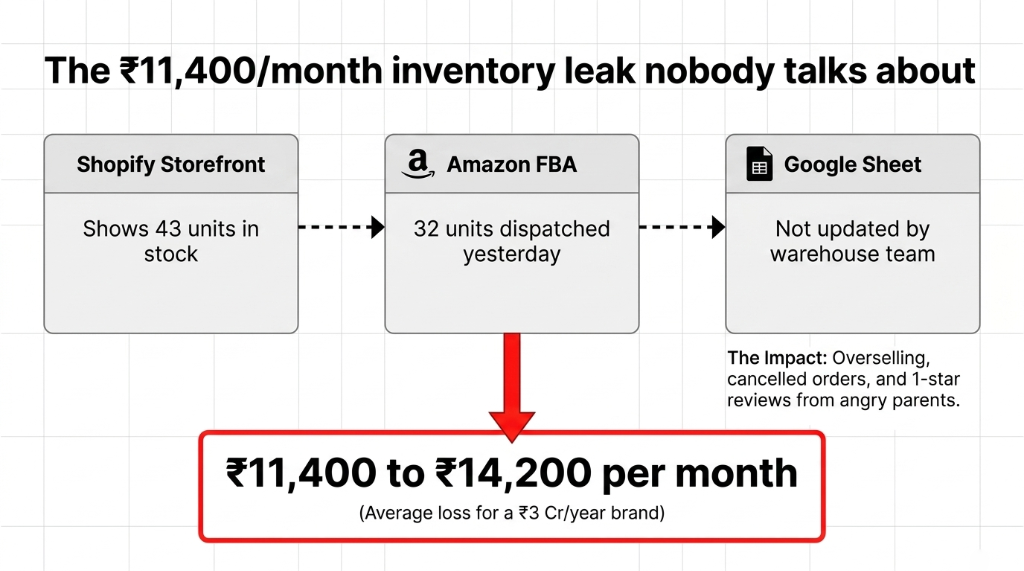
And that is before we talk about batch expiry. Baby products — formula-adjacent powders, lotions, oils, wipes — carry expiry dates. Without batch-level tracking in your system, you are not just risking a stockout; you are risking dispatching a near-expired product to a parent. That is a brand-ending event in the baby segment, where trust is the only currency that matters.
The India Baby Care Market
Market size: $5.18 billion in 2025, crossing $5.57 billion by end of 2026
Online channel growth: 12.57% CAGR — fastest of all distribution channels
Kidswear alone: $10.8 billion in 2024, growing at 5.11% CAGR
Why Your Current "Stack" Is Working Against You
Stop blaming your warehouse team. The problem is architectural.
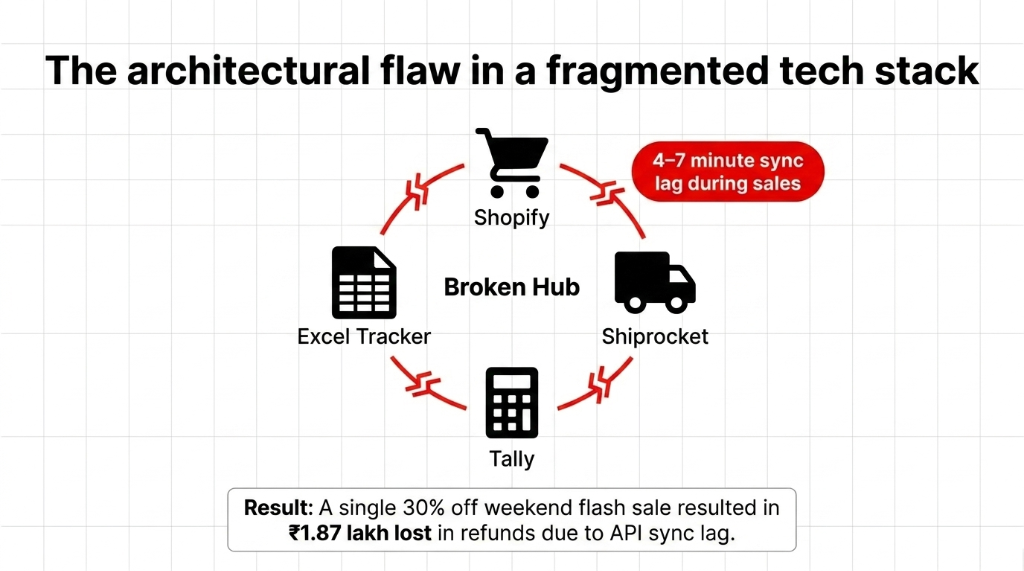
The typical Indian baby D2C brand in the $119,048–$595,238 range runs on: Shopify for the store, Shiprocket or Delhivery for logistics, QuickBooks or Tally for accounts, and a separate Excel tracker for inventory. These four systems do not talk to each other in real time. Every order creates a data gap between at least two of them.
The Shopify API Lag Nobody Warns You About
Shopify's inventory API has a sync lag of up to 4–7 minutes during high-traffic periods. Run a sale on your muslin baby blankets — say, 30% off for 6 hours — and you will oversell by 15–20 units before the system catches up.
We watched a kids apparel D2C brand lose $2,226 in refunds from a single weekend flash sale because of this exact lag.
Meanwhile, your accountant is reconciling three different data sources at month-end, manually matching Shiprocket COD remittances with QuickBooks entries, and somehow the numbers never agree. She is not bad at her job. The system is bad at its job.
What ERP Actually Fixes (With Real Numbers)
Here is what an Odoo ERP implementation does for a baby/kids D2C brand doing $238,095–$1.19M ARR.
Channel Sync That Actually Works
Odoo's native Shopify connector plus multi-channel inventory management means when a unit of your teether set sells on Amazon, that stock is deducted across every channel in under 60 seconds — not the next morning when someone updates the Sheet. For a brand managing 400–1,200 SKUs across 3 channels, this cuts channel conflict cancellations by 73% within the first 90 days.
Batch and Expiry Tracking at Lot Level
Every batch of your baby lotion, diaper rash cream, or organic cereal snack carries a lot number in Odoo. The system automatically flags stock nearing expiry and routes older batches to dispatch first (FEFO — First Expired, First Out). We implemented this for a baby personal care brand and they stopped their expiry write-offs — which were running at $738/month — entirely within 60 days.
Multi-Warehouse + 3PL Integration
If you are working with Shiprocket, Delhivery, or a third-party fulfillment center, Odoo integrates directly via API. Your pick-pack-ship flow becomes automated. A packing instruction error that used to take 15 minutes to investigate now takes 47 seconds. That matters when you are processing 400 orders on a Monday morning after a weekend sale.
Returns and COD Reconciliation on Autopilot
COD is still 43–55% of orders for most Indian D2C baby brands. Reconciling COD remittances from Delhivery against your Tally entries is a horror show without ERP. Odoo's accounting module pulls the remittance data, matches it to the order, and flags discrepancies automatically.
Real Client Recovery
One of our clients recovered $2,738 in unaccounted COD remittances in the first reconciliation cycle after go-live. That money was sitting in Delhivery's system, invisible to their Tally setup.
Demand Forecasting for Seasonal Spikes
Baby products have brutal seasonality — winter skin care, summer diaper rash spikes, back-to-school apparel in June–July. Odoo's AI-assisted demand forecasting (which Braincuber enhances with custom ML models) analyses your last 18 months of sales and tells you exactly how much stock to order before a peak. Not a gut feel. A number.
The Controversial Take Nobody Wants to Hear
Everyone in the Indian D2C ecosystem is selling you the idea of hiring a "growth team" and spending more on Meta ads. Do not. Not until your operations are locked.
We have seen brands spending $9,524–$14,286/month on performance marketing while bleeding the same amount in operational inefficiencies — wrong items shipped, return processing delays, stockouts during peak demand, and reconciliation errors. You are filling a leaking bucket with expensive water.
Hiring More Ops Staff Is Not Scaling. It Is Bloating.
Without ERP
A team of 6 managing 800 orders/day manually will be a team of 14 managing the same 800 orders when you hit 1,600. Per-order processing cost: $0.56–$0.62
With Odoo ERP
Move from 6 ops staff to 3 while doubling order volumes. Per-order processing cost drops to $0.23
What Implementation Actually Looks Like
| Weeks | Phase | What Actually Happens |
|---|---|---|
| 1–2 | Discovery + Data Audit | We get into your Shopify backend, Tally files, Shiprocket dashboard, and inventory master. We map every gap. (Yes, this is the uncomfortable part.) |
| 3–6 | Core Module Setup | Inventory, Purchase, Sales, Accounting, and Shopify/Marketplace integrations go live. Batch tracking and FEFO rules configured for your product catalog. Team gets trained on daily workflows. |
| 7–8 | Go-Live + Parallel Run | Odoo runs alongside your old system for 2 weeks. Every discrepancy gets investigated and fixed before full cutover. |
| 9+ | AI Layer Activation | Braincuber's custom AI modules — demand forecasting, returns classification, and automated reorder triggers — go live. System shifts from reactive to predictive. |
The Results You Should Actually Expect
Based on our last 37 implementations for baby, kids, and personal care D2C brands:
Verified Client Averages (37 Implementations)
Inventory Accuracy
From 67–74% → 98.3% within 60 days
COD Reconciliation
From 3.5 days/month → 4 hours/month
Returns Processing
From 7–9 days → 2.1 days average
Per-Order Cost
From $0.51–$0.62 → $0.19–$0.25
Stockout Events
Dropped by 81% in the first quarter
ROI Payback
Average client recoups implementation cost within 5.3 months
(These are actual averages from our client data. Your mileage will vary depending on your SKU count and channel mix — but the directional accuracy holds.)
Frequently Asked Questions
How long does Odoo ERP implementation take for a baby D2C brand?
For a brand doing $238,095–$1.19M ARR with 200–1,200 SKUs, implementation takes 8–10 weeks. This includes discovery, module configuration, Shopify and marketplace integration, batch tracking setup, team training, and a 2-week parallel run. Larger brands with multiple warehouses may need 12–14 weeks.
Will ERP work with Shiprocket, Delhivery, and our marketplace integrations?
Yes. Odoo integrates with Shiprocket, Delhivery, Amazon Seller Central, Flipkart, and Meesho via native connectors and APIs. Orders, shipment status, and COD remittances sync automatically. Setup takes 3–5 days per integration, and Braincuber handles the full API configuration.
What happens to our existing data in Shopify and Tally during migration?
Nothing gets deleted. We export historical order data, inventory master, and accounting entries, clean them, and import into Odoo. Your Shopify store stays live throughout. The only "downtime" is a 2–4 hour cutover window when we switch the live inventory sync — typically scheduled at 3–5 AM.
Is Odoo ERP affordable for a baby D2C brand doing under $595,238 ARR?
Yes — especially compared to alternatives. NetSuite starts at $36,000/year in licensing alone. Odoo's Community edition is open-source, and Braincuber's implementation costs for a startup-scale brand are a fraction of enterprise ERP costs. The average client recoups implementation cost within 5.3 months through recovered operational leakage.
Can ERP manage expiry and batch tracking for baby care products?
This is one of the strongest use cases. Odoo's lot tracking manages batch-level expiry dates, automates FEFO dispatch, and flags batches within 60–90 days of expiry for clearance. For baby food, skincare, and hygiene products, this prevents expired stock dispatches — which in the baby category is not just financial risk but a brand and liability risk. See how inventory management works.
Stop Bleeding Cash on Operations Your Current Stack Was Never Built to Handle
The Indian baby and kids D2C market is growing at 9.5% CAGR through 2030 — but the brands that will capture that growth are the ones whose operations can scale without breaking. Book our free 15-Minute Operations Audit. We will find your single biggest operational leak in the first call.
No slides. No pitch. Just a diagnosis.