
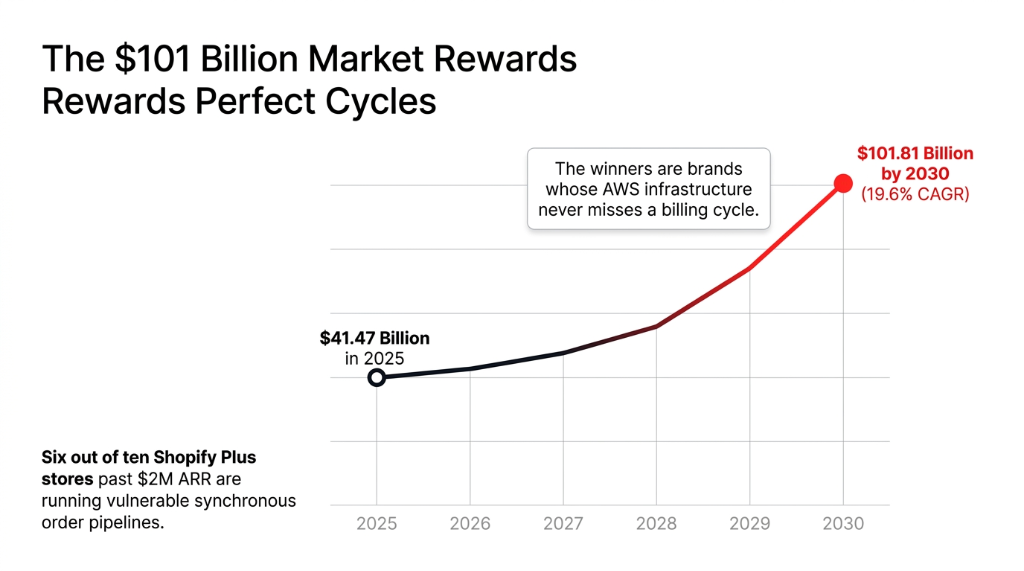
The subscription box market hit $41.47 billion in 2025 and is on a trajectory toward $101.81 billion by 2030 at a 19.6% CAGR. The brands winning that market are not the ones with the best curation. They are the ones whose AWS infrastructure never misses a billing cycle.
The Day Your Stack Breaks (And You Don't Know It)
Here is the ugly truth about subscription box e-commerce: Subscription Day — that one day per month when 70–80% of your active subscribers renew — is the single highest-traffic, highest-stakes event your infrastructure faces. Most brands are running it on a synchronous monolith that was fine at 500 subscribers and catastrophic at 15,000.
We constantly see this in clients past $2M ARR. Six out of ten Shopify Plus stores at that revenue threshold have synchronous order pipelines — meaning if your 3PL's API is slow for 8 seconds, your payment processor hangs, your inventory does not update, and a queue of 2,000 renewal jobs backs up like a freeway at rush hour.
Ghost Orders: The Silent Revenue Killer
One slow external call creates what engineers call "ghost orders" — charged, not fulfilled, invisible in your dashboard until a customer emails support furiously. The payment goes through, but the synchronous fulfillment API times out.
Hidden cost: $3,700–$8,100/month in refunds, support tickets, and lost trust
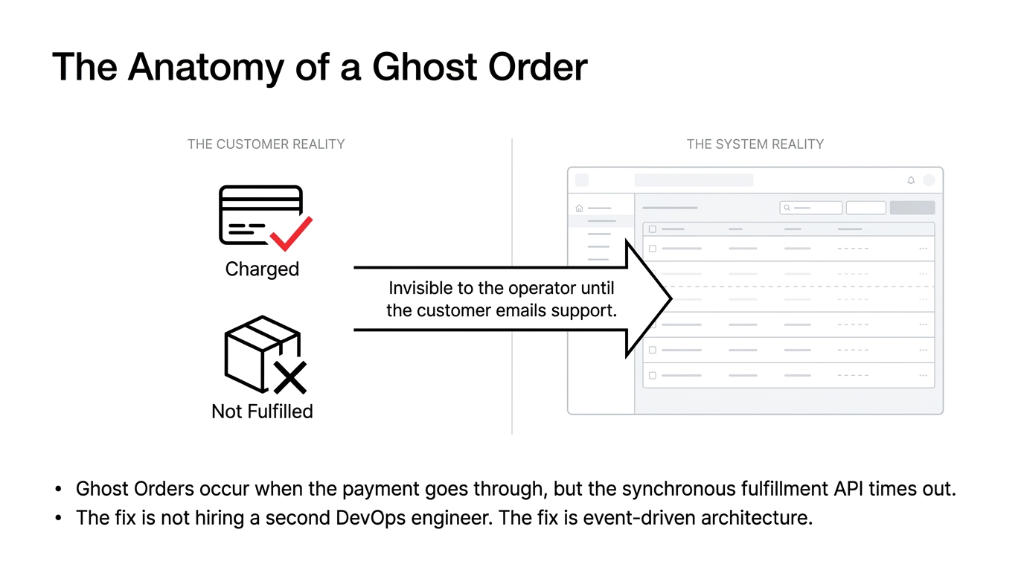
The fix is not hiring a second DevOps engineer. The fix is event-driven architecture on AWS.
Why Your Payment Retry Logic is Hemorrhaging Subscribers
Before we talk architecture, let us talk about the problem that genuinely costs subscription box operators the most money: involuntary churn.
30% of Your Churn is Not Real Churn
Problem: For every 100 customers who "cancel," 30 never actually chose to leave. Their card expired. The token refresh failed silently. Your retry logic fired at 2:00 AM on a Thursday when Stripe's authorization rates for European cards dip by 11%. They got a hard decline. Your system marked them churned. They moved on.
Recovery potential: 50–65% with smarter routing and retry logic
At $200,000/month MRR with 4% involuntary churn = $8,000/month recoverable by infrastructure alone
Look at what your current retry logic probably does. Attempt charge. Fail. Wait 3 days. Attempt again. Fail. Cancel. That is a straight line to customer loss.
What AWS-Native Retry Architecture Looks Like
AWS-Native Subscription Billing Stack
Amazon DynamoDB
Stores each subscription with NextPaymentDate and NextReminderDate attributes, timezone-aware
AWS Lambda + EventBridge
Triggers at 6:00 AM in the subscriber's timezone — not 2:00 AM server time
SQS FIFO Queues
Exactly-once payment processing. A Lambda timeout never double-charges a subscriber
Dead Letter Queues (DLQs)
Catch every failed charge, route to retry Lambda with exponential backoff over 14 days
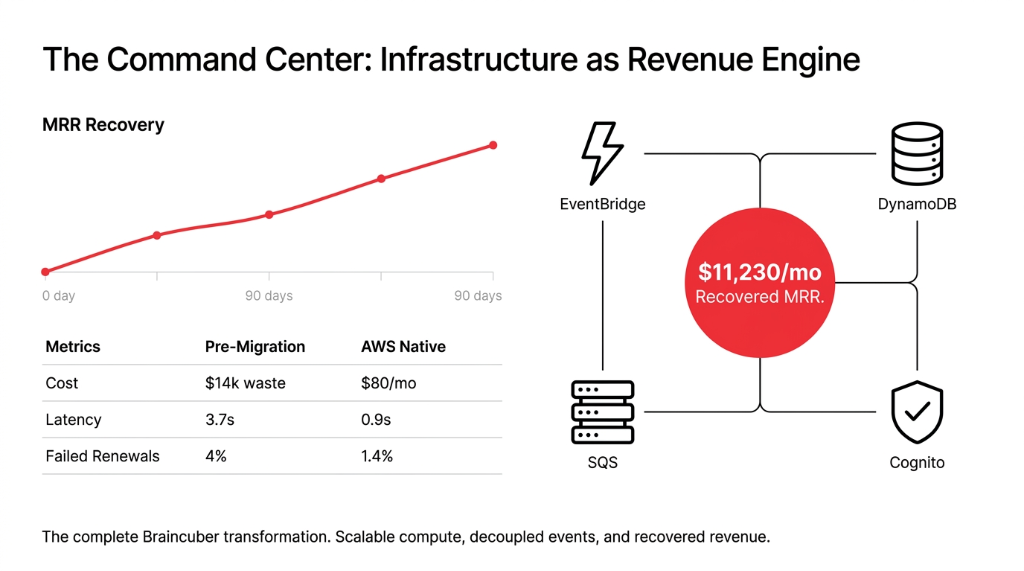
Real Result: $11,230/Month Recovered
Case: One brand we migrated to this architecture recovered $11,230/month in previously written-off failed renewals within the first billing cycle. That is not a marketing win. That is an infrastructure win.
Annual recovery: $134,760 — from a $80/month infrastructure cost
The SNS + SQS Fan-Out: How Subscription Day Stops Being a Crisis
On Subscription Day, your system needs to simultaneously: charge cards, update inventory, trigger fulfillment, fire welcome/renewal emails in Klaviyo, decrement warehouse stock counts, and log everything to your analytics pipeline. Do this synchronously — one step after another — and a single slow API response makes everything downstream wait.
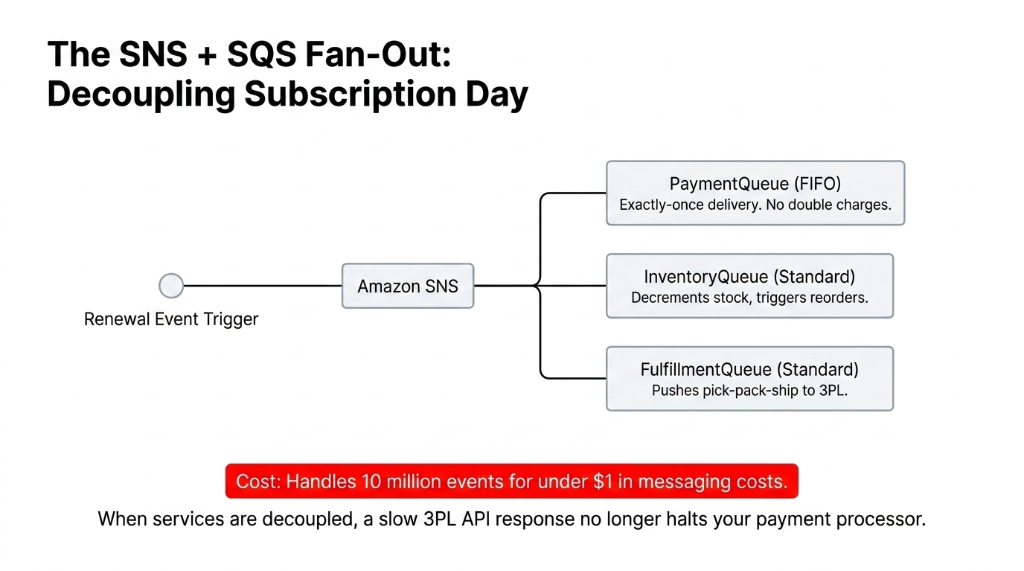
Amazon SNS broadcasts the renewal event to three SQS queues simultaneously:
| Queue | Type | Purpose |
|---|---|---|
| PaymentQueue | FIFO | Handles Stripe or Braintree charge processing. Exactly-once delivery. No double-charging. |
| InventoryQueue | Standard | Decrements box contents stock, triggers reorder alerts, syncs to your 3PL API. |
| FulfillmentQueue | Standard | Pushes pick-pack-ship instructions to ShipStation or ShipBob. |
The Cost Reality That Makes This a No-Brainer
SQS: $0.40 per million messages. A brand processing 50,000 subscription renewals monthly pays roughly $0.10/month in queue infrastructure.
SNS + SQS combined: Handles 10 million events for under $1 in messaging costs
Compare that to the $8,000+ in failed renewals it prevents. Nothing else comes close.
The Static Layer: Stop Paying EC2 to Serve Product Images
Here is something we see on almost every subscription box audit we run: brands paying $90–$180/month in EC2 costs to serve static product images, box reveal videos, and landing pages from the same server running their order logic.
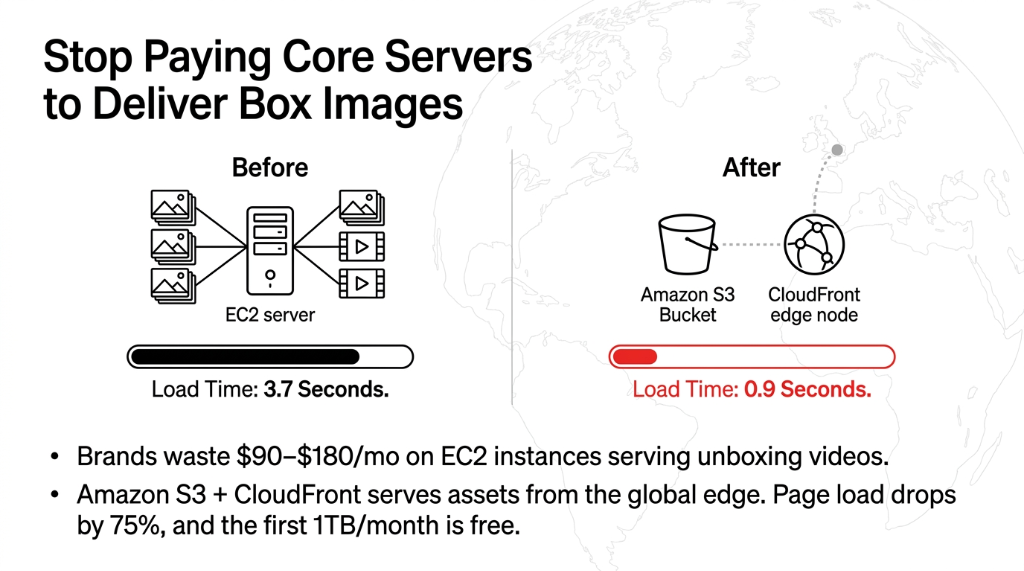
Amazon S3 + Amazon CloudFront. Product images, unboxing videos, and box preview content live in S3 buckets. CloudFront serves them from the nearest edge location globally — London subscribers get box images from Frankfurt, not from your US-East origin server.
The Numbers
Page load drops from 3.7 seconds to 0.9 seconds. Conversion on your subscription signup page goes up. EC2 stops doing work it was never meant to do. And the kicker: CloudFront's first 1TB of data transfer per month is free. You will likely never exceed it with 10,000 active subscribers.
Why Everyone Tells You to Buy EC2 (And Why That is Wrong at Your Scale)
The conventional advice for subscription box infrastructure: "Buy Reserved Instances, put everything on EC2, hire a DevOps person." Don't. Not until you are past $5M ARR.
| Metric | Always-On EC2 (3x t3.medium) | Lambda + API Gateway |
|---|---|---|
| Monthly Cost | ~$90/month | ~$38/month |
| Cost Reduction | — | 58% savings |
| Server Management | Patching, monitoring, "engineer on holiday" risk | Zero maintenance |
| Idle Waste | Paying 27 out of 30 days for unused headroom | Pay only when functions execute |
The US E-Commerce Average Nobody Talks About
$14,300/month in completely preventable AWS spend. For subscription box brands specifically, the leaks are usually: idle EC2 between Subscription Days, unoptimized S3 storage classes for old box content, and Lambda functions running at 1,024MB of memory when 256MB finishes the job in the same time.
Reserved Instances do make sense for your core application layer once you hit sustained traffic. At that point, they cut EC2 costs by up to 72%. But every brand we have audited below $3M ARR is massively over-provisioned on EC2.
The Authentication Layer Nobody Thinks About Until It Breaks
Your subscriber portal — where customers manage their box, skip a month, swap tier, or update their card — needs proper identity infrastructure. Most subscription box brands run this on Shopify's native account system or a bolted-on custom auth table in PostgreSQL. Both break at scale.
Amazon Cognito handles subscriber sign-up, sign-in, and access control. It manages 10,000 monthly active users for free. It integrates directly with your Lambda billing functions, meaning your payment processing code can verify a subscriber's session token before touching any card data. Supports social login (Google, Apple) which cuts subscription sign-up friction by measurably more than any A/B test you will run on your headline copy.
(Yes, your Shopify developer will tell you to just use Shopify's customer API. The problem is Shopify's API rate limit hits a wall during peak events, and your subscriber portal depends on real-time data that Shopify's API delivers inconsistently under load.)
What Braincuber Builds for Subscription Box Brands
We are a cloud infrastructure and AI partner at Braincuber Technologies, and we have built AWS-native architectures across subscription commerce, D2C brands, and recurring revenue businesses in the US, UK, UAE, and Singapore. Our subscription box builds typically include:
The Braincuber Subscription Box Stack
▸ DynamoDB recurring payment schema with timezone-aware billing triggers
▸ SNS + SQS fan-out architecture for Subscription Day with DLQ churn recovery
▸ Lambda-based webhook handlers for Stripe, Braintree, and PayPal recurring billing
▸ CloudFront + S3 static delivery with origin failover
▸ Amazon Cognito subscriber portal with Shopify–Odoo ERP integration for inventory sync
▸ AWS SageMaker churn prediction models that flag at-risk subscribers 14 days before their renewal date
The Result Across Our Subscription Box Clients
$11,000–$22,000/month recovered in the first 90 days across failed payment recovery, infrastructure cost reduction, and eliminated cart abandonment on the subscriber portal.
Don't let a $0.40/million SQS queue be the reason you are losing subscribers to competitors who figured this out before you.
Frequently Asked Questions
Which AWS services are most critical for subscription box e-commerce?
The non-negotiable stack is DynamoDB for subscription data storage, Lambda for billing triggers, SQS FIFO for payment processing queues, SNS for event fan-out on renewal day, and CloudFront + S3 for static content delivery. Together, this architecture handles 50,000+ renewals/month for under $200/month in infrastructure costs.
How does AWS prevent failed subscription payments from churning customers?
DynamoDB stores each subscriber's NextPaymentDate. Lambda triggers retry logic on a timezone-aware schedule. SQS Dead Letter Queues catch every failed charge and route it to exponential backoff retry over 14 days. This setup recovers up to 65% of what would otherwise be involuntary churn from card failures.
When should a subscription box brand move from Shopify hosting to AWS?
Once your active subscriber count exceeds 3,000 or your monthly renewal volume creates a single-day traffic spike more than 10x your daily average, a synchronous Shopify-native architecture starts dropping orders. That is the migration trigger, not ARR alone.
How much does a production-ready AWS subscription billing architecture cost?
For a brand processing 50,000 renewals/month: SQS costs ~$0.10, SNS costs ~$0.50, Lambda costs under $10, DynamoDB costs ~$25–$60 depending on throughput. Total sits at roughly $35–$80/month — less than a single engineer-hour debugging a dropped payment in a monolith.
Can Braincuber integrate this AWS architecture with an existing Shopify store?
Yes. We build Shopify–AWS integration layers that sync orders, subscriber status, and inventory in real time using AWS EventBridge and Lambda. Shopify remains the customer-facing storefront. AWS handles the billing engine, fulfillment queue, and analytics pipeline — including Odoo ERP integration for brands managing warehouse operations end-to-end.
Stop Losing Subscribers to Infrastructure That Costs Less to Fix Than Your Next Influencer Campaign
Book our free 15-Minute Cloud Architecture Audit — we will identify your biggest billing failure point in the first call.