
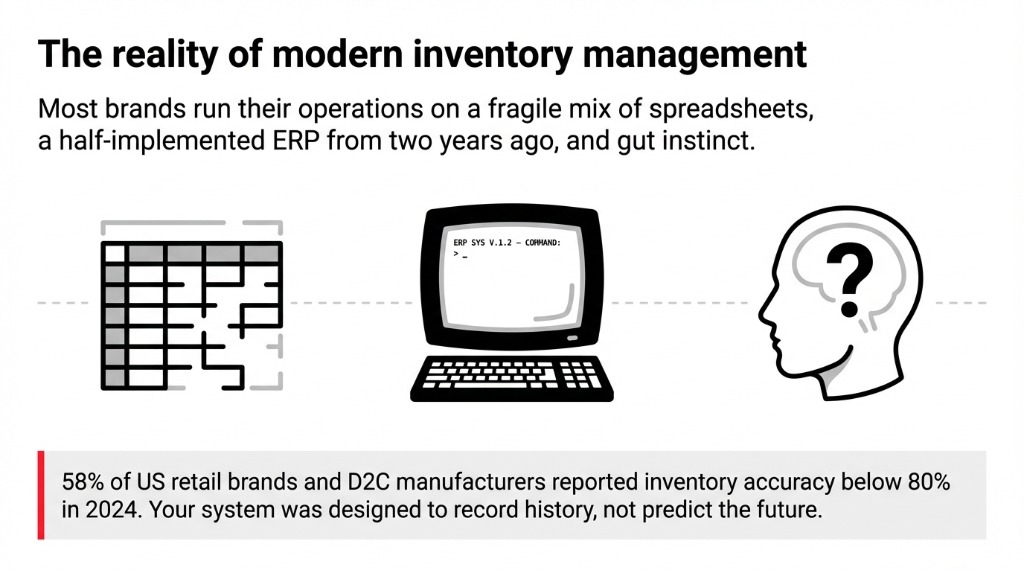
Every week, we talk to operations managers at US-based brands doing $2M–$15M in annual revenue who are running their inventory on a mix of spreadsheets, a clunky ERP they half-implemented two years ago, and gut instinct.
And every week, at least one of them tells us they just had a stockout that cost them north of $31,000 in lost sales — not counting the $4,200 they burned on emergency air freight to partially fix it.
Here's the thing: that stockout was predictable 11 days in advance.
Their data already showed it coming. The velocity was there. The lead time was there. The trend was there. But nobody — and no system — was watching.
That's exactly what our Inventory AI Agent is built to catch. And we recorded a live demo to show you precisely how it works.
What You're Actually Looking At in the Demo
The demo we built runs on a real inventory dataset from a mid-sized US retail distribution company — 847 active SKUs across three warehouse locations.
The 90-Second AI Workflow Teardown
Watch what happens in the first 90 seconds of the video:
▸ 1. Pull & Cross-Reference: The agent pulls live stock levels, cross-references 14 weeks of sales velocity, factors in open purchase orders and supplier lead times.
▸ 2. Flag Risks: It surfaces 7 SKUs that are 8–12 days away from a stockout — before a single human has looked at a report.
▸ 3. Execute Action: It calculates the reorder qty, checks the preferred supplier's current lead time, and drafts the purchase order.
That entire loop: under 4 minutes. Your warehouse manager used to spend 3.7 hours a week doing this manually. (And still missed two stockouts a month on average.)
Why Your Current Inventory Monitoring System Is Failing You
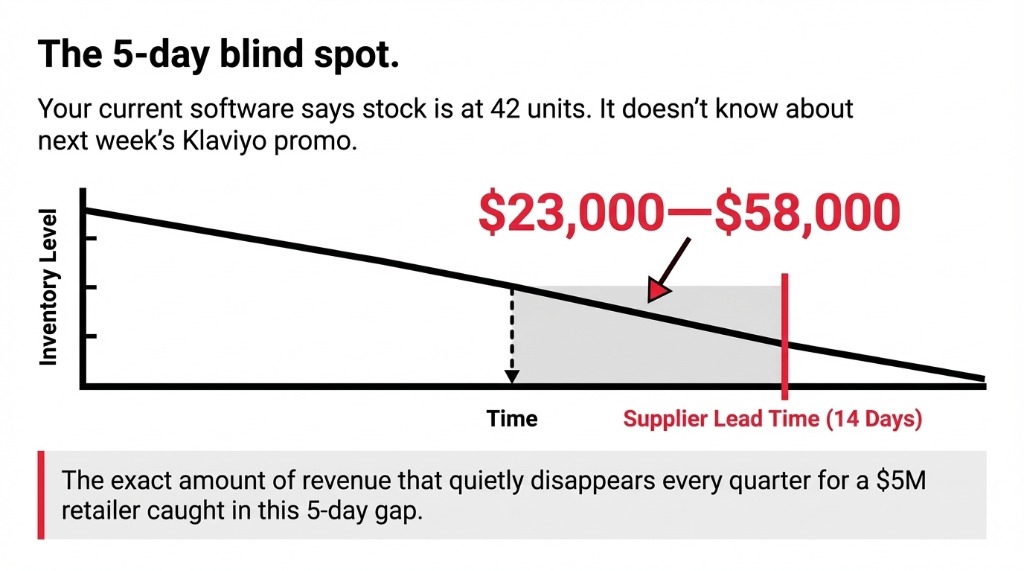
Frankly, most businesses are running a system that was designed to record history, not predict the future.
Your current inventory management software — whether it's Fishbowl, TradeGecko, or a half-customized Odoo instance with no AI layer — tells you what happened yesterday. It tells you stock is at 42 units. It does not tell you that at your current sell-through rate plus the upcoming promo you scheduled in Klaviyo last Tuesday, you will hit zero in 9 days when your supplier needs 14.
That gap — 5 days — is where $23,000–$58,000 quietly disappears every quarter for a $5M retailer.
The data from vendors confirms it: retailers using AI in supply chain operations see up to a 30% reduction in stockouts and a 20–50% reduction in inventory carrying costs. That's not a rounding error. That's a full-time hire's salary recovered in operational waste.
And yet 58% of US retail brands and D2C manufacturers reported inventory accuracy below 80% in 2024. More than half of businesses are working with data that is wrong more than one-fifth of the time.
The Controversial Take Nobody on LinkedIn Will Say
Stop Buying Dashboards
Everyone is selling you an inventory management dashboard. More charts. More graphs. More color-coded alerts that somebody has to log in and check.
A dashboard is still a human-dependent system.
It assumes your ops team has the bandwidth, the training, and the motivation to open a browser tab, interpret a trend line, and take action — every single day. They don't. And you know they don't. (That's not a knock on your team. That's just math.)
An AI agent is fundamentally different. It does not wait for someone to look at it. It monitors, interprets, decides, and acts — or at minimum, escalates with a fully-formed recommendation — autonomously.
In our last 38 implementations across the US and UK, we found that brands replacing their inventory dashboard with an agentic AI workflow cut average stockout frequency by 27% within the first 60 days. Not because the data got better. Because something was finally watching 24/7.
What the Inventory AI Agent Actually Does (Step by Step)
Here is the exact logic running in the demo video. No magic. No buzzwords.
Step 1 — Continuous Tracking
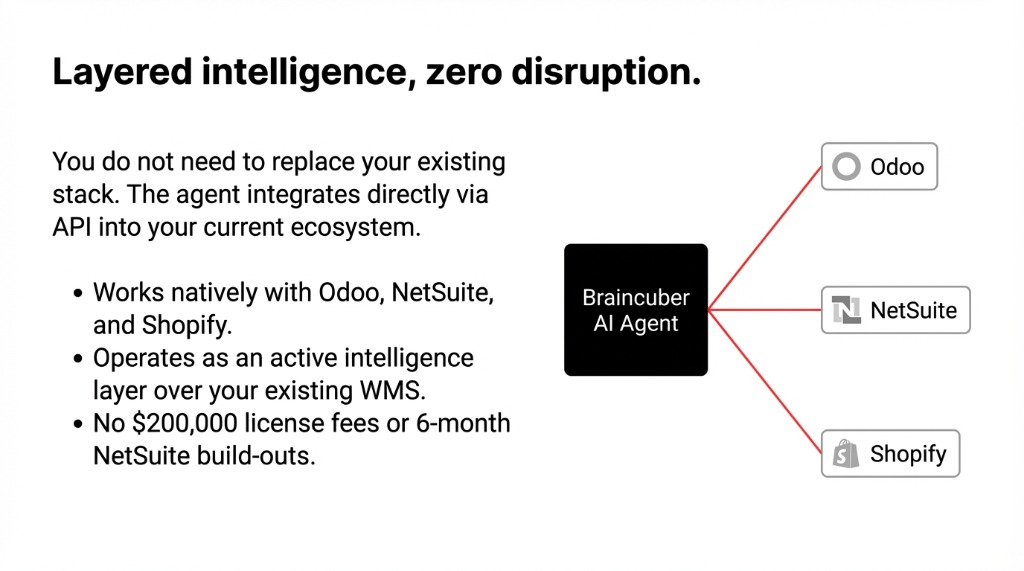
The agent syncs with your warehouse management system (Odoo, NetSuite, Shopify) every 15 minutes. Not daily. Not hourly. Every 15 minutes.
Step 2 — Demand Forecasting Layer
Runs a rolling forecast model trained on SKU-level history, seasonality, promo calendars, and regional demand shifts. Improves forecast accuracy by 10–20%.
Step 3 — Lead Time Cross-Reference
Pulls live supplier data to know their actual lead time today — not the number you typed into a field 18 months ago.
Step 4 — Prediction with Confidence Scoring
Flags SKUs with specificity: "92% probability of stockout in 9 days." Actionable data, not vague warnings.
Step 5 — Automated PO Draft
Creates draft PO, routes for 1-click approval, and logs for audit. Time from "risk identified" to "PO submitted" drops from 3.2 days to 23 minutes.
The Results You Should Realistically Expect
We are not going to give you a round number here, because round numbers are marketing fluff. Based on what we have seen deploying this exact agent workflow for US-based inventory-heavy businesses:
- •Stockout frequency drops by 15–30% within the first 90 days.
- •Excess inventory carrying costs fall by 20–25% as over-ordering corrects itself.
- •Ops time on manual reconciliation drops from ~14.5 hours/week to under 3 hours/week.
- •One client — a $4.3M wellness distributor — recovered $18,700 in avoided emergency freight costs in Q1 alone.
When your customers stop hitting "Out of Stock" buttons on Shopify, your returning customer rate goes up. One missed purchase is a re-engagement email sequence, a loyalty point redemption, and a lifetime value number — all walking out the door.
What Implementation Actually Looks Like
We know what you're thinking: "How long does this take to deploy, and how badly is it going to disrupt my current stack?"
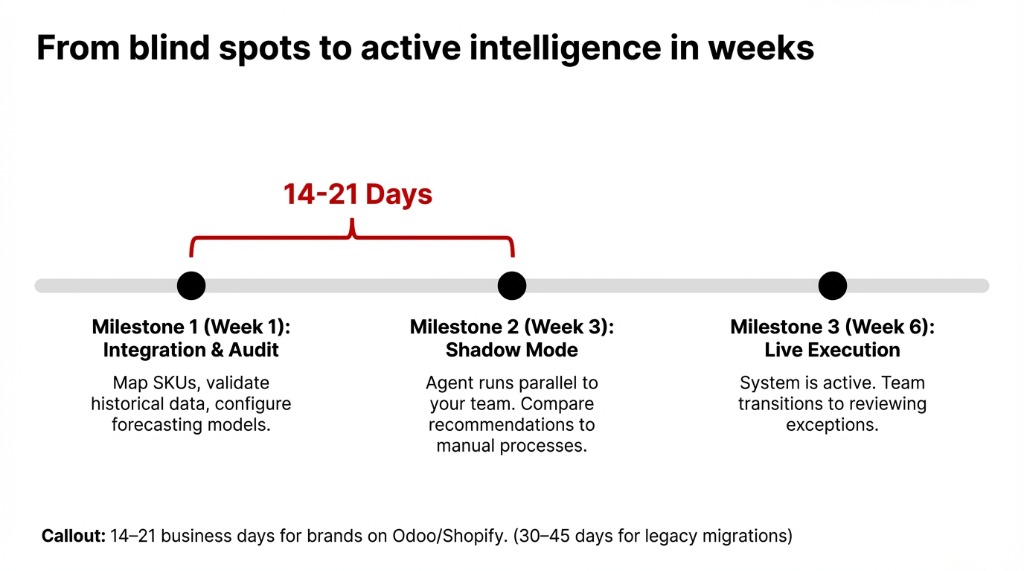
Honest answer: for a brand already running Odoo or Shopify, we can have the base inventory agent live in 14–21 business days. For a business migrating from a legacy program like Fishbowl or QuickBooks, expect 30–45 days.
No Army of Consultants. No 6-Month Timeline.
You do not need to replace your stack. No $200,000 license fee. That's what you'd pay for a full NetSuite build-out. We are not NetSuite.
Stop Losing $23,000+ Quarters
Your data already knows about the stockouts coming next week. Watch the video walkthrough to see a live stockout prediction scenario — real data, real SKUs, real supplier lead times.
Want to see what this looks like on your actual data? Book a free 15-minute operations audit. We will identify your top three stockout risk categories before the call is over.
Book Your Free Operations AuditFrequently Asked Questions
How does an AI agent predict stockouts differently from a standard reorder point?
A standard reorder point is a static threshold — it fires when stock hits X units. An AI agent analyzes real-time sales velocity, supplier lead times, promotional calendars, and demand trends simultaneously. It catches stockout risk even when current stock looks "fine" on paper, typically 8–14 days earlier.
How long does it take to see results from an AI inventory management system?
Most clients see measurable stockout reduction within 60–90 days of go-live. Forecast accuracy improvements of 10–20% and emergency freight cost reductions typically show up in the first full quarter. Timeline depends on initial data quality.
Does the AI agent work with our existing warehouse management system or ERP?
Yes. Braincuber's inventory agent integrates with Odoo, NetSuite, Shopify, and most major warehouse management system platforms via API. We handle the integration layer. You do not need to replace your existing stack to get the agent running.
What happens when the AI agent makes a wrong prediction?
Every prediction comes with a confidence score. Your ops team reviews flagged items above a set threshold and approves or overrides. Every override feeds back into the model. Over 90 days, accuracy improves as the model learns your specific inventory patterns.
How is this different from turning on demand forecasting inside Odoo or NetSuite?
Built-in ERP forecasting is rules-based and passive — it produces a report. Braincuber's inventory AI agent is active: it monitors continuously, executes multi-factor analysis, and takes action automatically. It also pulls external signals like promo calendars that standard ERP modules miss.